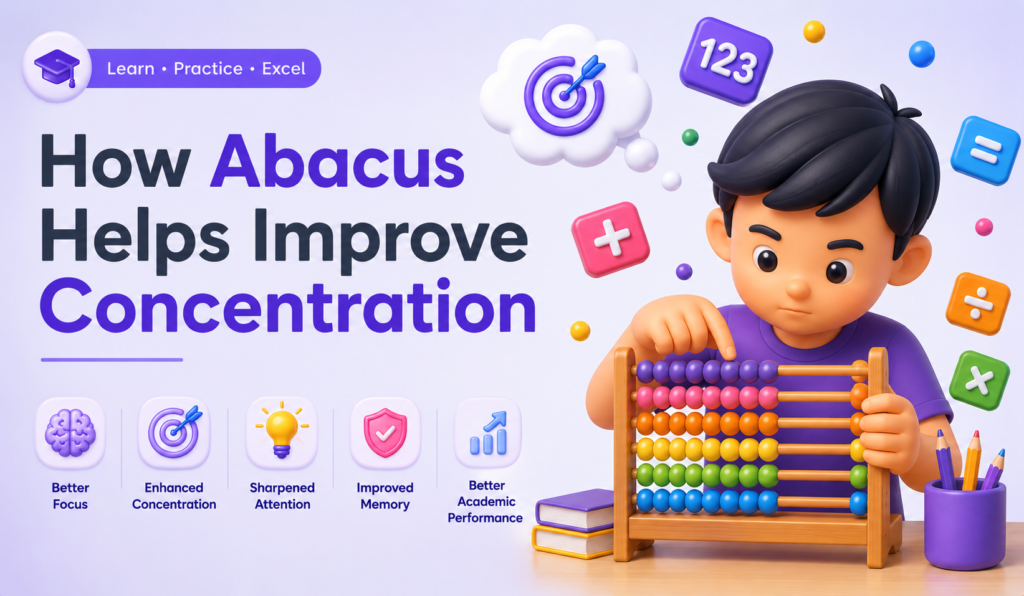
How Abacus Helps Improve Concentration in Children
In today’s fast-moving digital world, children are easily distracted by mobile phones, television, video games, and social media. Many parents struggle to help their children stay focused on studies for longer periods. Concentration has become one of the most important skills for academic success and overall development. This is where abacus training plays an important role in shaping a child’s learning abilities.
Parents across the country are now realizing that abacus learning is not just about mathematics. It is a
complete brain development program that improves memory, focus, listening skills, visualization, and analytical thinking. Understanding How Abacus Helps Improve Concentration can help parents make better decisions for their children’s future.
Abacus training encourages children to use both sides of the brain while solving calculations mentally. This process keeps the brain active and improves the child’s ability to stay attentive for longer periods. Over time, children become more disciplined, focused, and confident in academics and daily activities.

What is Abacus Learning?
Abacus learning is a method of mental arithmetic training that uses a counting tool called the abacus. Children first learn calculations using beads, and later they begin visualizing the abacus mentally to solve problems quickly without physical tools.
This method activates the left and right brain simultaneously. The left brain handles logic and calculations, while the right brain supports imagination and visualization. When both parts work together, children develop stronger concentration and faster thinking abilities.
Today, abacus education is becoming increasingly popular among parents who want their children to improve their academic performance naturally and effectively.
How Abacus Helps Improve Concentration in Children in Daily Learning
One of the biggest advantages of abacus training is its ability to improve concentration levels in children. During abacus practice, students must focus carefully on bead movements, hand coordination, and mental visualization. Even a momentary loss of focus can result in wrong answers.
This continuous practice trains the brain to stay alert and attentive. Over time, children naturally develop the ability to focus on tasks for longer durations without getting distracted.
Children who regularly practice abacus often show improvements in:
- Classroom attention
- Listening abilities
- Reading focus
- Homework completion
- Memory retention
- Problem-solving skills
The structured exercises involved in abacus learning gradually strengthen the child’s mental discipline and patience.
Why Concentration is Important for Children
Concentration is the foundation of successful learning. A child who can focus properly understands concepts faster, remembers lessons better, and performs more confidently during exams.
Poor concentration can affect many areas of a child’s life, including:
- Academic performance
- Communication skills
- Confidence levels
- Creativity
- Time management
Many children lose focus because their brains are overloaded with distractions. Abacus training provides a healthy and productive way to train the brain naturally.
Understanding How Abacus Helps Improve Concentration becomes especially valuable during the primary school years, when children are building strong learning habits and improving their thinking skills.
The Role of Visualization in Abacus Training
Visualization is one of the most powerful aspects of abacus learning. After mastering physical bead movements, students begin imagining the abacus in their minds while solving calculations.
This mental visualization requires intense focus and attention. Children learn to create clear mental images and manipulate them quickly. This process strengthens concentration and memory simultaneously.
Visualization exercises also improve:
- Iagination power
- Mental clarity
- Observation skills
- Information processing speed
As children become more skilled in mental arithmetic, they also become better at concentrating on academic subjects such as mathematics, science, and reading comprehension.
How Abacus Helps Improve Concentration Through Regular Practice
Consistency is one of the key factors behind the success of abacus learning. Daily practice sessions train the brain like a workout exercise. Just as physical exercise strengthens muscles, mental practice strengthens concentration abilities.
Regular abacus practice encourages children to:
- Stay calm while solving problems
- Pay attention to details
- Avoid unnecessary distractions
- Complete tasks with accuracy
- Develop self-discipline
Children who initially struggle with focus often show remarkable improvement after joining structured abacus classes.
Parents frequently notice positive behavioral changes, including increased patience, improved listening habits, and better study routines at home.
Abacus Training and Brain Development
Abacus learning is widely known for stimulating overall brain development. Unlike traditional memorization methods, abacus training activates multiple senses and thinking processes simultaneously.
As children move the beads and solve calculations mentally, multiple brain functions become active at the same time.
- Visual processing
- Hand-eye coordination
- Logical reasoning
- Memory recall
- Auditory listening
This complete brain engagement helps improve neural connections and cognitive flexibility.
Research and educational experts often highlight How Abacus Helps Improve Concentration because focused mental activities improve long-term learning efficiency.
Benefits of Improved Concentration in Academics
Children with better concentration perform more effectively in school and extracurricular activities. Strong focus allows students to absorb information faster and reduce careless mistakes.
Some academic benefits include:
Better Understanding of Subjects
Focused children understand lessons more clearly because they pay closer attention during classes.
Faster Homework Completion
Children with good concentration complete assignments more efficiently without frequent distractions.
Improved Exam Performance
Better focus helps students remember concepts during exams and avoid confusion.
Increased Confidence
As concentration improves, children feel more capable and motivated to participate actively in school activities.
These improvements often encourage children to develop a more positive attitude toward learning.
How Parents Can Support Abacus Learning at Home
Parents play an important role in helping children gain maximum benefits from abacus training. A positive learning atmosphere at home can help children stay consistent and motivated in their practice.
Here are some simple ways parents can help:
- Encourage daily practice routines
- Reduce screen distractions during study time
- Appreciate small achievements
- Maintain a calm learning environment
- Ensure proper sleep and healthy habits
Children respond positively when parents show interest in theirlearning journey. Even short daily practice sessions can produce noticeable improvements overtime.
How Abacus Helps Improve Concentration Better Than Traditional Methods
Traditional learning methods often focus mainly on memorization. In contrast, abacus learning actively engages the brain through movement, visualization, and mental calculations.
This active learning approach keeps children mentally involved instead of passively memorizing information. Because students must continuously visualize and calculate, their attention span gradually increases.
Abacus training also makes learning more interactive and enjoyable. Children often see it as a fun activity rather than stressful academic pressure.
As a result, students become naturally interested in concentrating and improving their skills.
Signs That a Child May Benefit from Abacus Training
Some children may especially benefit from abacus learning if they:
- Get distracted easily
- Struggle to complete homework
- Lose focus during classes
- Make careless mistakes frequently
- Lack confidence in mathematics
- Have short attention spans
Abacus training provides structured mental exercises that can help improve these challenges gradually and effectively.
Many parents notice significant improvement within a few months of consistent training.
Building Lifelong Skills Through Abacus Education
The benefits of abacus learning extend beyond childhood academics. Concentration, discipline, and mental focus are valuable life skills that help students succeed in future careers and personal development.
Children who develop strong concentration abilities early often become:
- Better decision-makers
- More organized learners
- Faster thinkers
- More confident communicators
- Independent problem-solvers
These skills continue to support them throughout higher education and professional life.
That is why many parents now search for the best abacus classes in india to give their children a strong foundation for future success.
Conclusion
Abacus learning is much more than a mathematics training program. It is a powerful brain development tool that helps children improve concentration, memory, visualization, and confidence naturally.
Understanding How Abacus Helps Improve Concentration allows parents to recognize the long-term value of mental arithmetic training. In a world full of distractions, helping children develop strong focus and learning discipline has become more important than ever.
With regular practice and proper guidance, abacus training can transform the way children learn, think, and perform academically. It encourages sharper attention, better listening skills, and improved mental clarity that benefit children throughout their lives.
By introducing abacus learning at an early age, parents can help children build the concentration and confidence needed for lifelong success.