
How to Choose the Right Abacus Learning Programme for Your Child
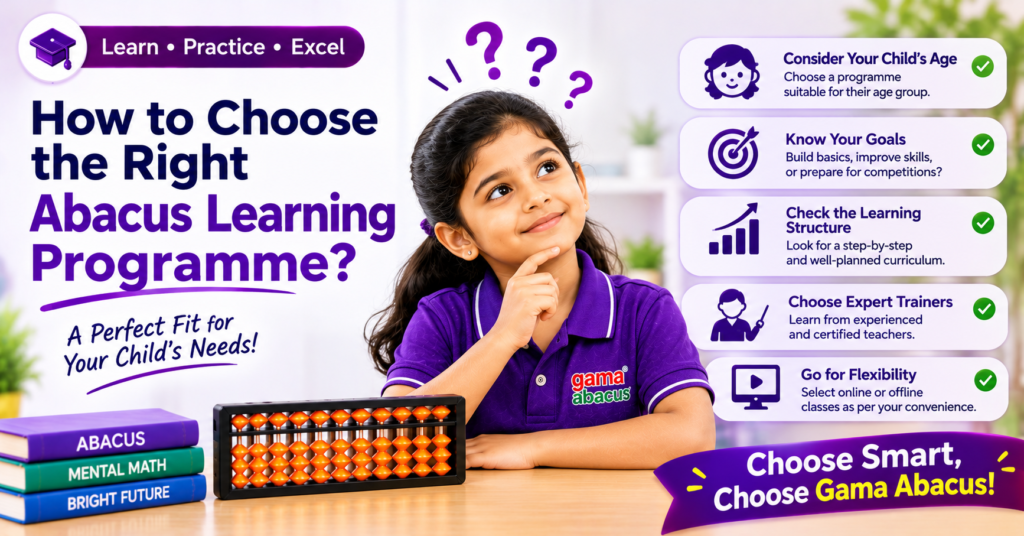
Choosing an additional learning programme for a child can be challenging for parents. With different teaching methods, course structures and learning centres available, it is important to understand what makes a programme suitable. How to Choose the Right Abacus Learning Programme is an important question to explore before making an enrolment decision. The right programme should match a child’s age, learning pace and ability while providing a clear path from basic concepts to more advanced calculations.
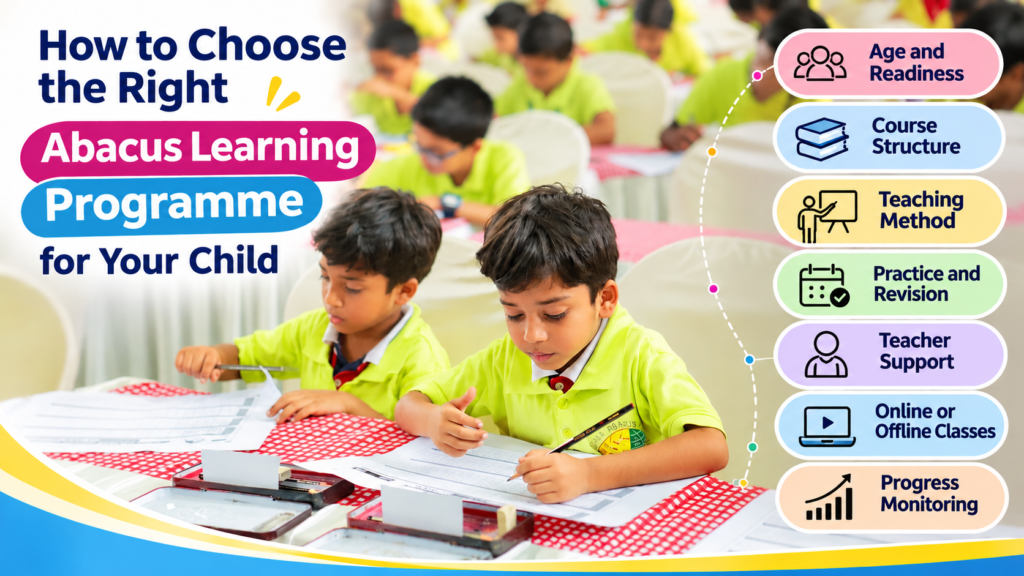
Abacus education introduces children to numbers through a visual and practical approach. However, not every programme follows the same curriculum, teaching style or practice schedule. Parents should look beyond advertisements and consider the quality of instruction, course progression, teacher guidance and opportunities for regular practice.
This guide explains the important factors parents should consider before selecting an abacus programme for their children.
Why Choosing the Right Abacus Programme Matters
Children have different learning styles. Some understand mathematical concepts quickly, while others need more time, repetition and individual attention. A suitable programme recognises these differences and provides an environment where children can gradually develop their skills.
Understanding How to Choose the Right Abacus Learning Programme helps parents focus on the actual learning experience instead of attractive promises or claims of instant results.
A well-structured programme should introduce concepts step by step. Children need opportunities to understand the abacus, practise calculations, correct mistakes and build confidence as they move through different stages.
The programme should also make learning enjoyable. Children are more likely to participate consistently when lessons are interactive, age-appropriate and supported by encouraging teachers.
1. Consider Your Child’s Age and Learning Readiness
Age is one of the first factors parents usually consider. Although many children begin abacus training during their early school years, readiness is not determined by age alone.
A child should be able to recognise basic numbers, follow simple instructions and participate in guided learning activities. Some children may be ready earlier, while others may benefit from starting a little later.
Before enrolling, consider whether your child is comfortable with basic number recognition, shows interest in number-based activities and can participate in a structured learning session.
When thinking about How to Choose the Right Abacus Learning Programme, avoid selecting a course only because other children of the same age have joined it. The programme should suit your child’s current understanding and learning readiness.
2. Check the Course Structure and Learning Levels
A clear curriculum is an important feature of a good abacus programme. Parents should understand what children will learn at the beginning and how lessons progress over time.
A structured course generally introduces basic abacus concepts before moving towards more challenging calculations. Students may gradually learn the following concepts:
- Understanding the abacus frame, rods and beads
- Recognising number values and place values
- Learning basic addition and subtraction
- Developing accuracy through guided exercises
- Moving towards multiplication and division
- Practising calculations with increasing complexity
- Developing mental visualisation techniques
Ask the learning centre whether it follows a defined syllabus and how students progress from one level to another.
An important part of How to Choose the Right Abacus Learning Programme is checking whether the curriculum provides a logical learning path rather than teaching disconnected calculation tricks.
Parents should also ask how the centre evaluates a student’s readiness before moving to the next level. Progress should be based on understanding and practice, not simply on completing a fixed number of classes.
3. Understand the Teaching Method
The teaching method has a direct influence on a child’s classroom experience. Some programmes focus heavily on completing exercises, while others give importance to explaining concepts and demonstrating techniques.
Children should first understand how the beads represent numbers and how their movements help them perform calculations. With regular guidance, they can gradually learn to perform operations more confidently.
Ask the centre to explain how a typical lesson is conducted. Find out whether teachers demonstrate concepts, allow students to practise independently and correct mistakes when necessary.
When evaluating How to Choose the Right Abacus Learning Programme, look for a teaching approach that balances explanation, demonstration and practice.
A child should not feel pressured to produce quick answers without understanding the method. Building a strong foundation is more valuable than rushing through lessons.
4. Look for Regular Practice and Revision
Abacus skills develop through consistent practice. Attending classes alone may not be enough to help children become comfortable with the techniques they learn.
A suitable programme should provide opportunities for revision and guided practice. Parents should understand how homework, worksheets, classroom exercises or other practice activities are used.
Regular practice helps children become familiar with bead movements and calculation patterns. It also allows them to identify areas where they need additional support.
Parents can ask how often students are expected to practise, whether revision exercises are provided, how mistakes are corrected and whether practice is adjusted according to each student’s level.
While researching How to Choose the Right Abacus Learning Programme, remember that the goal is to develop a manageable routine. Excessive practice or unnecessary pressure can make learning unpleasant. Short, consistent practice sessions with suitable guidance can help children remain engaged.
5. Check the Experience and Support of Teachers
Teachers play an important role in introducing concepts and guiding children through different learning stages. A teacher should understand the subject as well as the needs of young learners.
Parents can ask about the teacher’s abacus training, teaching experience and familiarity with the programme’s curriculum.
It is also useful to observe how teachers interact with students. Do they explain concepts patiently? Do they encourage children to ask questions? Do they provide additional guidance when a student finds a lesson difficult?
A supportive teacher understands that every child progresses differently.
Teacher quality is therefore an important factor in How to Choose the Right Abacus Learning Programme. Parents should look for instructors who can explain concepts clearly, encourage participation and provide guidancewhenstudentsface difficulties.
6. Compare Online and Offline Learning Options
Abacus programmes may be available through physical learning centres and online classes. Both formats can offer a structured learning experience when lessons are properly organised.
Offline classes allow children to learn in a classroom environment and interact directly with teachers and other students. Parents may find this format suitable when a convenient centre is available.
Online classes can provide flexibility for families who prefer learning from home. However, parents should check whether the sessions are conducted live, how students interact with teachers and how their practice is monitored.
Before choosing a format, consider your child’s comfort with technology, daily schedule, internet access and ability to participate in lessons.
The most suitable option is the one that allows the child to attend consistently and receive proper guidance. Comparing these arrangements is another useful step in How to Choose the Right Abacus Learning Programme.
7. Understand How Student Progress Is Monitored
A good learning programme should have a way to assess student development. Parents need to know whether their children are understanding concepts and applying the techniques taught in class.
Progress may be monitored through practice exercises, level assessments, classroom activities or periodic evaluations, depending on the programme.
Ask how parents are informed about their child’s performance. Find out whether teachers identify specific areas that require additional practice.
Do not judge progress only by calculation speed. Accuracy, understanding, confidence and the ability to apply learned methods are also important.
When deciding How to Choose the Right Abacus Learning Programme, look for a centre that communicates progress clearly and helps students improve at a suitable pace.
8. Check Whether the Programme Matches Your Child’s Goals
Different families may have different expectations from abacus education. Some parents want their children to become familiar with number operations, while others are interested in developing visual calculation skills through structured training.
It is important to identify your expectations before selecting a programme.
However, avoid expecting abacus training to solve every academic difficulty or produce instant results. It should be considered a supplementary learning activity that supports mathematical practice.
Parents interested in brain development for children should also understand that learning outcomes depend on several factors, including the child’s participation, consistency and overall learning environment.
The programme should have realistic learning objectives and explain what students are expected to achieve at each stage. This helps parents understand whether the course matches their expectations.
9. Ask About Class Size, Timings and Fees
Practical details also influence the learning experience. Parents should check class schedules, batch sizes, course duration and fee structure before enrolling.
Smaller batches may make it easier for teachers to observe individual students, although the actual level of attention depends on the teaching arrangements.
Ask whether missed classes can be attended later, whether additional practice support is available and whether there are separate charges for learning materials or assessments.
Do not select a programme based only on the lowest fee. Compare what is included, the curriculum, teacher support and overall learning arrangements.
Parents searching for best abacus classes in India should compare the actual learning experience and course details instead of depending only on promotional claims.
10. Observe a Trial Class or Speak to the Centre
If possible, request a demonstration or trial session before making a decision. This gives parents an opportunity to understand the teaching style and see how children respond to the learning environment.
Observe whether the lesson is organised, whether instructions are easy to follow and whether the teacher encourages participation.
You can also speak to the centre about its teaching methodology, course levels, student assessments and parent communication.
These details can help you make a decision based on actual information instead of relying entirely on promotional claims. A direct conversation with the centre can also help clarify questions about course duration, class schedules and learning materials.
How GAMA Abacus Can Fit Into Your Search
Parents exploring structured abacus education can also learn about the programme offered by GAMA Abacus. Its course information and teaching approach can be reviewed through the official website before making an enrolment decision.
Visit the GAMA Abacus website to explore its abacus training, online learning options and course structure. Parents can use this information to understand the programme and ask relevant questions before selecting a suitable learning option.
For families considering abacus classes for kids, it is useful to understand how lessons are organised, what the course includes and how students are guided through the different stages.
Ultimately, How to Choose the Right Abacus Learning Programme should lead parents towards a practical decision: selecting a programme with a clear curriculum, appropriate teaching support and a learning schedule that suits their child.
Conclusion
Selecting an abacus programme is an important decision because the quality of the learning experience can influence a child’s interest and progress. Parents should consider the curriculum, teaching method, teacher support, practice schedule, class format and progress assessments before enrolling.
The most important part of How to Choose the Right Abacus Learning Programme is finding a course that understands the child’s learning needs, builds mathematical concepts step by step and encourages consistent practice without unnecessary pressure.
Take time to compare available options, ask questions and understand the course structure. A suitable programme can give children a positive opportunity to explore numbers, practise calculations and develop useful learning habits through mental math classes and structured abacus learning.