
Can Abacus Help Children Who Are Weak in Mathematics?
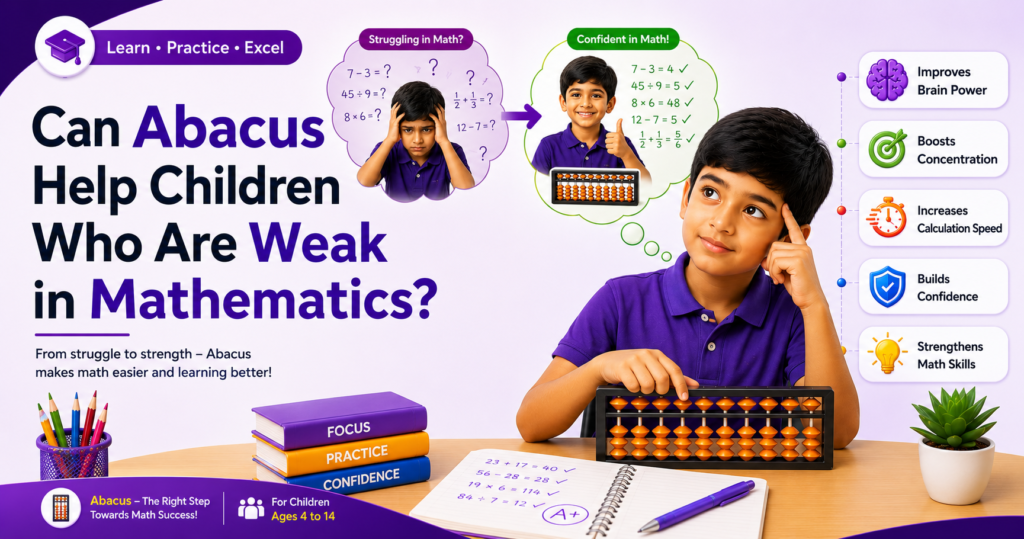
Mathematics is one of the most important subjects in a child’s academic journey, yet it is also one of the biggest challenges for many students. Some children quickly understand numbers, while others struggle with even basic calculations despite spending hours practicing. If you’ve ever wondered, Can Abacus Help Children Who Are Weak in Mathematics?, you’re certainly not alone. Parents across the world ask this question when they notice their child losing confidence, avoiding math homework, or feeling anxious before every mathematics test.
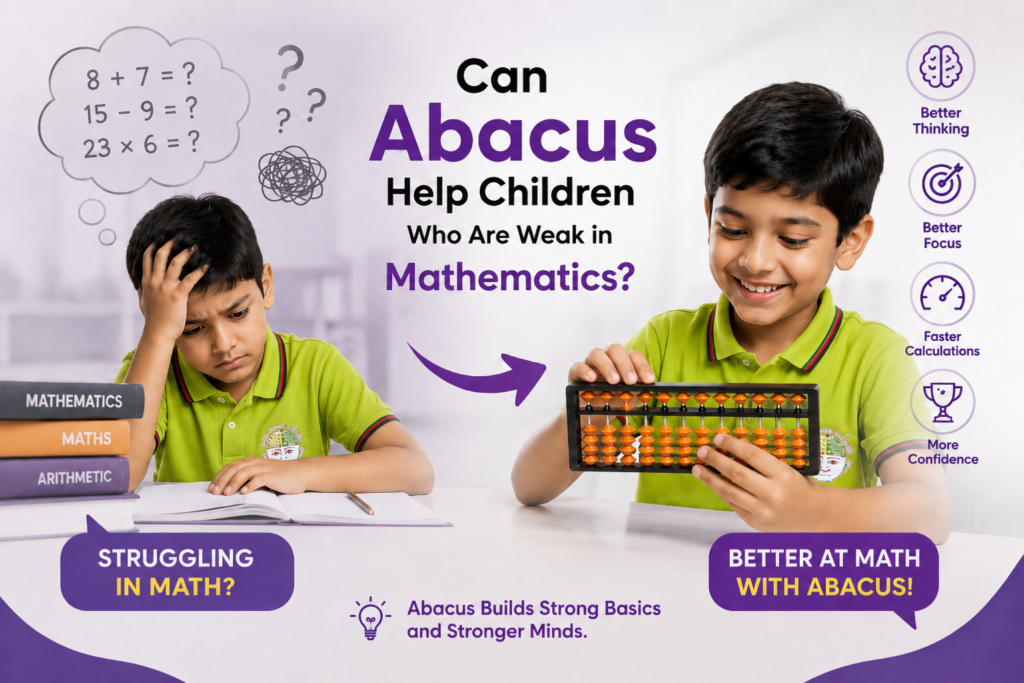
The good news is that being weak in mathematics doesn’t mean a child lacks intelligence. Every child learns differently, and many simply need a better approach to understanding numbers. Instead of relying only on memorization, children need strong number sense, logical thinking, and confidence in solving problems. This is where abacus training has gained recognition as an effective learning method.
Unlike traditional teaching methods that often focus on repetitive practice, abacus helps children visualize numbers, improve calculation speed, and develop confidence through consistent learning. Over time, children begin enjoying mathematics instead of fearing it.
Why Do Some Children Find Mathematics Difficult?
Before looking for solutions, it’s important to understand why children struggle with mathematics in the first place. Every child has unique learning abilities, and the reasons behind poor math performance can vary significantly.
Some children find it difficult to understand basic number concepts, while others lose confidence after making repeated mistakes. Many students become anxious during classroom activities because they worry about giving the wrong answer.
Common reasons include:
- Weak understanding of numbers
- Difficulty remembering calculation methods
- Slow calculation speed
- Fear of making mistakes
- Low confidence
- Poor concentration during lessons
- Lack of regular practice
When these challenges continue for a long time, children often begin believing they are “bad at math,” even though they simply need a different learning strategy.
Can Abacus Help Children Who Are Weak in Mathematics?
The answer is yes but not because the abacus is a shortcut to solving mathematical problems.
Abacus works by strengthening the fundamental skills children need before they can confidently solve calculations. Instead of asking children to memorize answers, it teaches them how numbers work.
Children first learn to use a physical abacus to represent numbers visually. As they become comfortable with this process, they gradually begin imagining the beads mentally while solving arithmetic problems.
This transition develops stronger number sense, better concentration, and faster mental calculation.
Rather than depending on guesswork, children begin understanding mathematics in a structured and logical way.
Many parents searching online for Can Abacus Help Children Who Are Weak in Mathematics are surprised to discover that consistent abacus practice builds confidence along with calculation skills.
Common Challenges Children Face in Mathematics
Many parents assume poor marks automatically mean their child isn’t trying hard enough.
In reality, children often face invisible challenges that affect their mathematical performance.
Weak Number Sense
Some children recognize numbers but don’t fully understand the relationships between them.
For example, they may know that 8 + 7 equals 15 after repeated practice, but they don’t understand why.
Without strong number sense, every new calculation feels like memorizing another answer.
This makes mathematics increasingly difficult as children progress through school.
Fear of Making Mistakes
Children who have been corrected repeatedly may begin fearing incorrect answers.
Instead of attempting questions confidently, they hesitate, overthink, and sometimes leave questions unanswered.
This fear often becomes stronger after poor exam results or classroom embarrassment.
Parents may notice that their child says:
“I’m not good at math.”
“I’ll probably get it wrong.”
“Math is too difficult.”
These statements usually reflect a lack of confidence rather than a lack of ability.
Slow Calculation Speed
Many children understand mathematical concepts but require too much time to complete simple calculations.
During classroom tests, they spend several minutes solving basic arithmetic while classmates move ahead.
This creates additional pressure and increases anxiety.
As stress builds, calculation speed becomes even slower, creating a frustrating cycle.
Helping children improve calculation efficiency can significantly reduce this pressure.
Difficulty Concentrating
Mathematics requires sustained attention.
Children who lose focus while solving problems often:
- Skip important steps
- Misread questions
- Copy numbers incorrectly
- Forget the operation required
Even small lapses in concentration can lead to unnecessary mistakes.
Improving attention is therefore just as important as improving calculation skills.
Can Abacus Help Children Who Are Weak in Mathematics?
One of the greatest strengths of abacus training is that it improves several essential learning skills simultaneously.
Instead of focusing only on arithmetic, children gradually strengthen:
- Concentration
- Memory
- Visualization
- Logical thinking
- Numerical understanding
Because these skills develop together, children become more confident learners rather than simply faster calculators.
This is one reason many parents notice improvements beyond mathematics alone.
How Abacus Changes the Learning Experience
Traditional mathematics often emphasizes memorizing formulas and repeating similar exercises.
While practice is important, children also need to understand the logic behind numbers.
Abacus creates a more interactive learning experience.
Instead of seeing numbers as abstract symbols, children begin visualizing them through bead movements.
This physical and mental connection makes mathematical concepts easier to understand.
As children experience repeated success, their confidence naturally begins to grow.
Learning gradually becomes enjoyable instead of stressful.
Can Abacus Help Children Who Are Weak in Mathematics?
Parents often expect immediate improvement after enrolling their child in an abacus program.
However, learning is a gradual process.
Children first become comfortable using the physical abacus.
Then they begin visualizing the beads mentally.
Eventually, calculations become faster, smoother, and more accurate.
Each small achievement builds confidence.
Instead of feeling afraid of mathematics, children begin approaching new problems with curiosity.
This positive attitude is one of the biggest reasons abacus training produces lasting results.
Signs Your Child May Benefit from Abacus Training
Every child learns differently, but certain signs suggest that additional support could be helpful.
You may notice that your child:
- Avoids mathematics homework
- Takes too long to complete calculations
- Counts on fingers frequently
- Becomes anxious before math exams
- Loses confidence after making mistakes
- Gives up easily when solving difficult questions
- Finds mental calculations challenging
Recognizing these signs early allows parents to introduce supportivelearning methods before frustration becomes a long-term habit.
How Abacus Strengthens Mathematical Skills
Children who struggle with mathematics often believe that success depends on memorizing formulas. While memorization has its place, true mathematical ability comes from understanding how numbers work together. Abacus training helps children develop this understanding in a practical and engaging way.
Instead of simply remembering answers, children learn to visualize numbers and solve problems step by step. This strengthens their foundation and makes advanced mathematical concepts easier to understand later.
Regular practice also encourages children to think independently instead of relying on guesswork or repeatedly asking for help.
Many parents searching for answers to Can Abacus Help Children Who Are Weak in Mathematics? discover that the greatest benefit is not just faster calculation but a complete change in their child’s attitude toward learning.
Building Confidence Through Small Successes
Confidence grows one achievement at a time.
When children successfully solve problems during abacus practice, they begin believing in their own abilities. This positive experience gradually replaces fear with curiosity.
Instead of worrying about getting every answer perfect, children become willing to try new problems because they know mistakes are part of learning.
This change in mindset often carries over into school, where children participate more actively in mathematics lessons and answer questions with greater confidence.
Parents frequently ask, Can Abacus Help Children Who Are Weak in Mathematics? because they want more than better marks they want their child to enjoy learning again.
If you’re still asking Can Abacus Help Children Who Are Weak in Mathematics?, remember that confidence develops through regular practice and gradual improvement.
Better Memory and Concentration
Mathematics requires children to remember numbers, follow multiple steps, and stay focused until the problem is solved.
Abacus exercises strengthen these abilities by encouraging children to:
- Listen carefully
- Observe patterns
- Visualize numbers
- Perform mental calculations
- Stay focused throughout each activity
Over time, this consistent mental exercise improves concentration, which can benefit classroom learning as well.
Parents often notice improvements in homework habits, attention during lessons, and overall academic confidence.
Regular abacus learning encourages children to become active thinkers rather than passive learners.
Parents often search Can Abacus Help Children Who Are Weak in Mathematics? when they notice their child struggling with focus as well as calculations.
Improving Speed Without Sacrificing Accuracy
Many children think solving mathematics quickly means rushing.
In reality, speed develops naturally when understanding improves.
Children who have strong number sense spend less time figuring out basic calculations because they recognize number patterns more easily.
This allows them to complete schoolwork with greater confidence while maintaining accuracy.
Families researching Can Abacus Help Children Who Are Weak in Mathematics? are often pleased to discover that children don’t simply become faster they become more careful and accurate as well.
Supporting Your Child at Home
Parents have an important role in helping children develop positive learning habits.
Here are a few practical strategies:
Encourage Daily Practice
Short daily sessions are usually more effective than long weekend study periods.
Celebrate Progress
Praise effort, consistency, and improvement instead of focusing only on marks.
Create a Positive Learning Environment
Allow children to ask questions without fear of criticism.
Avoid Comparisons
Every child learns at a different pace.
Build Healthy Study Habits
Consistent routines help children feel more confident before school tests and examinations.
These simple habits work even better when combined with structured learning.
Choosing the Right Learning Program
Not every learning program follows the same teaching approach.
Parents should look for experienced instructors, structured lesson plans, regular practice, and individual attention.
If you’re comparing different options, research the best abacus classes in India before making a decision. A well-designed program focuses on conceptual understanding instead of rote memorization.
Many parents choose abacus classes for kids because they combine interactive learning with gradual skill development, helping children improve naturally without unnecessary pressure.
When exploring the best abacus classes in India, consider factors such as instructor experience, student progress tracking, and teaching methods. The right learning environment can make a significant difference in your child’s confidence and long-term mathematical growth.
Some families also compare mental math classes before enrolling. While mental calculation is important, a structured abacus program builds the strong foundation needed for children to develop these skills gradually. This approach also supports brain development for children by strengthening concentration, visualization, and logical thinking.
As more parents search for the best abacus classes in India, they often discover that choosing a quality program is an investment in their child’s confidence as much as their academic performance.
Real Progress Takes Time
Every child learns differently.
Some children begin showing greater confidence within a few months, while others improve gradually over a longer period.
The most important factor is consistency.
Children who practice regularly usually experience steady improvement in:
- Number sense
- Mental calculation
- Confidence
- Concentration
- Classroom participation
Parents wondering Can Abacus Help Children Who Are Weak in Mathematics? should remember that lasting improvement comes from patience, encouragement, and regular practice rather than expecting overnight results.
Conclusion
If you’ve ever asked yourself, Can Abacus Help Children Who Are Weak in Mathematics?, the answer is yes when it is taught through a structured and supportive learning approach. Abacus helps children strengthen number sense, improve concentration, increase confidence, and develop faster mental calculation skills. More importantly, it changes the way children think about mathematics. Instead of seeing numbers as something to fear, they begin viewing them as challenges they can solve with confidence. With consistent practice and encouragement, every child has the opportunity to build stronger mathematical skills and enjoy learning with confidence.