
My Child Is Good at Other Subjects but Struggles with Maths: Causes, Solutions, and How Abacus Can Help
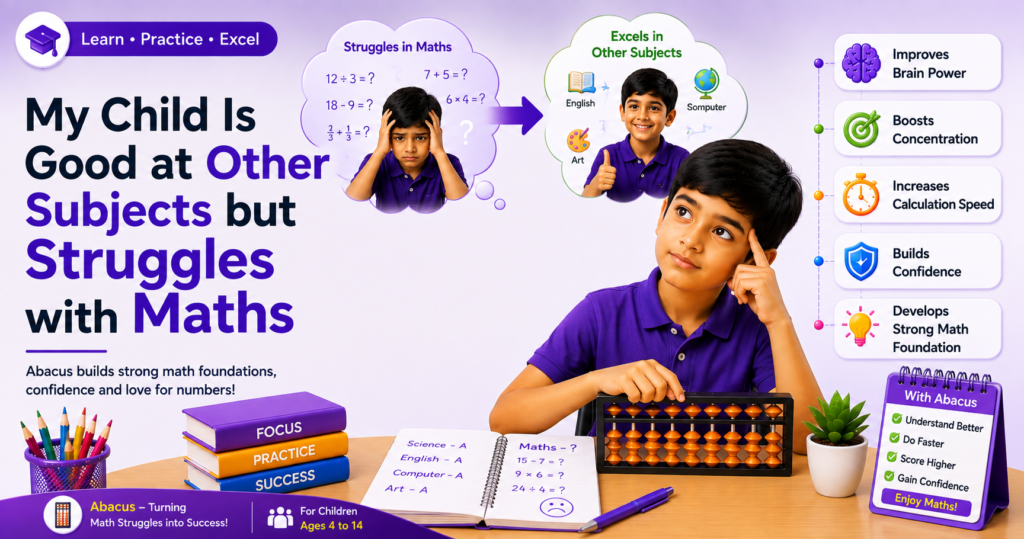
Most parents feel confused when their child performs well in subjects like English, Science, and Social Studies but struggles to score well in mathematics. They often wonder why a child who is intelligent, hardworking, and curious finds maths so difficult. If you’ve ever thought, My Child Struggles with Maths you’re certainly not alone.
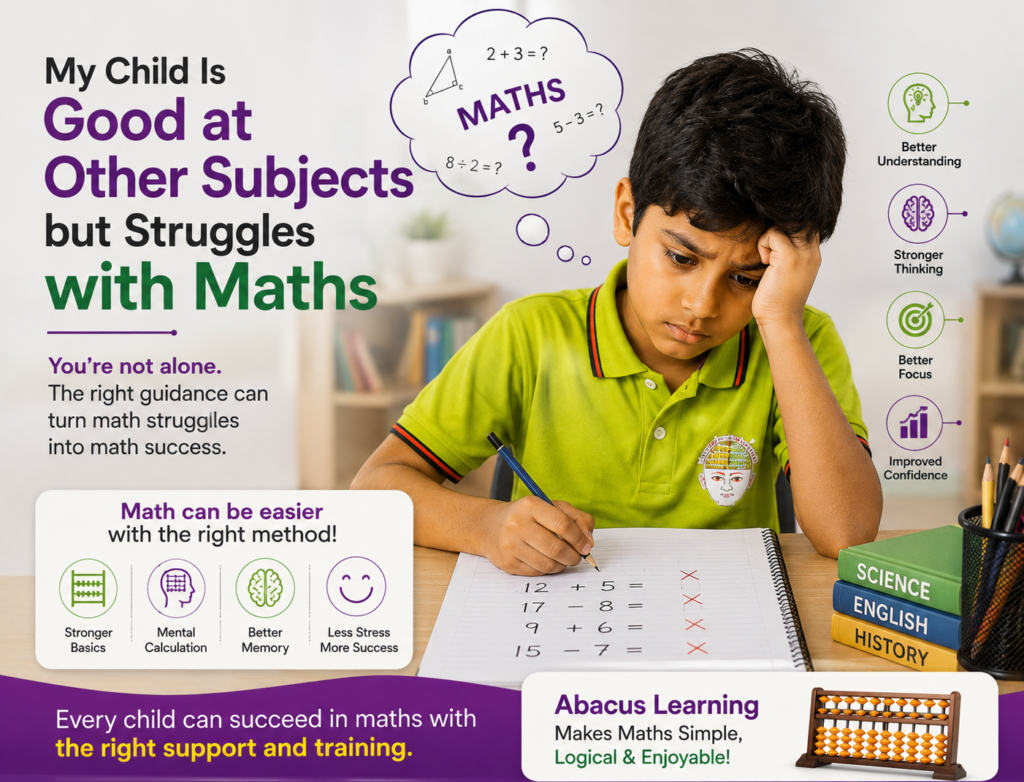
The truth is that mathematics requires a different set of skills compared to many other subjects. While reading-based subjects often rely on memory and understanding, maths demands number sense, logical thinking, concentration, and the ability to solve problems step by step. The good news is that struggling with maths doesn’t mean your child lacks ability. With the right learning approach and consistent practice, every child can improve.
One proven way to build these skills is through abacus training. Rather than teaching children to memorize answers, abacus helps them understand numbers, think logically, and solve calculations with greater confidence.
My Child Is Good at Other Subjects but Struggles with Maths
Many parents assume that if a child excels in most school subjects, mathematics should also come naturally. Unfortunately, that’s not always the case.
Every subject develops different abilities. A child may have excellent reading comprehension, creative writing skills, or a strong memory for science concepts, but still find calculations challenging.
Mathematics is unique because it combines logical thinking, concentration, speed, and accuracy. Even a small gap in basic number understanding can make higher-level concepts much more difficult.
Instead of comparing your child with others, it’s more helpful to understand where the difficulty begins. Once the root cause is identified, improvement becomes much easier.
Why Some Children Find Maths More Difficult Than Other Subjects
Every child learns differently. Some naturally enjoy numbers, while others feel more comfortable with language or creative subjects.
There are several reasons why maths can become challenging.
Weak Number Sense
Some children memorize multiplication tables or formulas without truly understanding how numbers relate to one another.
As lessons become more advanced, this weak foundation makes solving problems increasingly difficult.
Children often know the method but struggle to apply it independently.
Fear of Making Mistakes
Many children become anxious after repeatedly getting incorrect answers.
Unlike subjects where partial answers may earn marks, mathematics usually requires complete accuracy.
After several disappointing experiences, children may begin avoiding maths altogether.
This fear affects confidence more than ability.
Slow Calculation Speed
A child may understand mathematical concepts perfectly but require extra time to solve calculations.
During classroom activities or examinations, this slower pace creates pressure.
As anxiety increases, even simple calculations become more difficult.
My Child Struggles with Maths
One important thing parents should remember is that struggling with maths is not a sign of low intelligence.
Many successful scientists, writers, artists, and professionals once found mathematics difficult during childhood.
The difference is that they eventually developed stronger number skills through consistent practice and the right guidance.
Children should never feel labelled as “weak in maths.” Instead, they should be encouraged to see mathematics as a skill that can improve over time.
Signs Your Child Needs Extra Support
Some children openly say they dislike mathematics, while others hide their struggles.
Watch for these common signs:
- Frequently counting on fingers
- Taking much longer than classmates to finish calculations
- Avoiding maths homework
- Feeling nervous before maths exams
- Making careless calculation mistakes
- Losing confidence after incorrect answers
- Saying “I’m just not good at maths.”
Recognizing these signs early allows parents to provide support before frustration becomes a habit.
My Child Struggles with Maths
Many parents immediately increase homework when they notice poor maths marks.
Although regular practice is important, simply giving children more worksheets isn’t always the answer.
If a child doesn’t understand the basic concepts, repeating similar questions often increases frustration instead of confidence.
A better approach is to strengthen the child’s understanding of numbers first.
Once the foundation improves, calculations become easier and learning feels much less stressful.
How Abacus Helps Children Build Strong Mathematical Skills
Abacus training focuses on building the skills that mathematics truly depends on.
Instead of memorizing answers, children learn to visualize numbers and understand relationships between them.
This method gradually improves:
- Number sense
- Concentration
- Mental calculation
- Memory
- Logical thinking
- Confidence
As children become comfortable working with numbers, they begin approaching maths with greater confidence instead of fear.
Parents often notice that their child starts solving calculations independently without depending on finger counting or guessing.
Building Confidence One Step at a Time
Confidence in mathematics doesn’t appear overnight.
It develops through repeated success.
Every correctly solved calculation reminds children that they are capable learners.
Instead of worrying about mistakes, they begin focusing on finding solutions.
This positive change often influences classroom participation, homework habits, and examination performance.
Children who once avoided mathematics frequently become more willing to ask questions and attempt challenging problems.
How Parents Can Help at Home
When a child struggles with maths, it’s natural for parents to step in and help. However, the way you support your child can make a significant difference.
Instead of focusing only on marks, try to build a positive attitude toward learning. Encourage your child to ask questions, celebrate small improvements, and remind them that making mistakes is part of learning.
Many parents searching for answers to My Child Struggles with Maths discover that encouragement and patience often have a greater impact than extra homework.
Here are a few simple habits you can follow:
- Practice maths for 15–20 minutes every day instead of long study sessions.
- Praise effort as much as results.
- Avoid comparing your child with siblings or classmates.
- Make maths a part of everyday life through shopping, cooking, or simple games.
- Encourage your child to explain how they arrived at an answer instead of simply giving the correct solution.
These small changes gradually improve confidence and reduce the fear associated with mathematics.
Why Abacus Makes Learning Maths Easier
One of the biggest reasons children struggle with maths is that numbers often feel confusing and abstract.
Abacus changes this learning experience by helping children visualize numbers instead of memorizing them. As they continue practicing, they begin performing calculations mentally with greater confidence and accuracy.
Parents who ask My Child Struggles with Maths are often surprised to see how children become more interested in maths once they start understanding numbers instead of simply remembering formulas.
Regular abacus learning also develops concentration, visualization, and logical thinking skills that benefit children well beyond mathematics.
Confidence Changes Everything
Children who repeatedly experience failure in maths often begin believing that they are “not a maths person.”
This belief can stop them from trying new questions or participating in classroom discussions.
Confidence grows through consistent success.
Every correctly solved calculation reminds children that improvement is possible. Over time, this positive experience changes the way they approach mathematics.
Many families who once worried, My Child Struggles with Maths , notice a remarkable difference after their child begins enjoying the learning process rather than fearing it.
Choosing the Right Learning Program
Not every learning program offers the same experience.
Look for instructors who focus on understanding rather than memorization. A good program should encourage children to think independently while providing regular practice and individual attention.
Many parents compare different mental math classes before making a decision. While mental calculation is valuable, choosing a structured abacus program helps children build strong number concepts before moving to advanced mental calculations.
If you’re exploring the best abacus classes in India, pay attention to the teaching methodology, curriculum, student progress tracking, and classroom environment rather than choosing solely based on fees.
Similarly, when comparing the best abacus classes in India, look for experienced instructors who make learning enjoyable and provide consistent guidance throughout the course.
Parents looking for abacus classes for kids often prefer centres where children feel motivated, confident, and excited to learn every week.
Every Child Learns at a Different Pace
One of the biggest mistakes parents make is expecting immediate improvement.
Learning mathematics is a gradual process.
Some children gain confidence within a few months, while others need more time to strengthen their foundations.
If you’ve ever wonderedMy Child Struggles with Maths , remember that progress should never be measured only through test scores.
Look for positive changes such as:
- Greater willingness to solve maths problems.
- Improved concentration during study time.
- Less dependence on finger counting.
- Better calculation accuracy.
- Increased classroom participation.
These small improvements usually lead to stronger academic performance over time.
The Long-Term Benefits of Abacus
Abacus is much more than a calculation tool.
Regular practice contributes to brain development for children by strengthening focus, memory, visualization, and logical reasoning.
These skills support learning across many school subjects and help children become more confident learners overall.
Many parents searching for the best abacus classes in India eventually realize that the real value of abacus lies not only in improving maths marks but also in developing lifelong learning skills.
Children who build confidence early often become more willing to accept challenges, solve problems independently, and enjoy learning throughout their academic journey.
If you’re still asking My Child Struggles with Maths , remember that the right guidance, consistent practice, and a supportive learning environment can make a lasting difference.
Conclusion
If you’ve been thinking, “My Child Struggles with Maths,” don’t lose hope. Many children experience the same challenge, and it does not reflect their intelligence or potential. With patience, encouragement, and the right learning approach, they can develop stronger number sense, greater confidence, and better problem-solving skills. Abacus training provides a structured way to strengthen these abilities while making mathematics enjoyable instead of stressful. Every child has the ability to improve, and with consistent support, success in maths is absolutely achievable.