
Why Does My Child Solve Maths So Slowly?
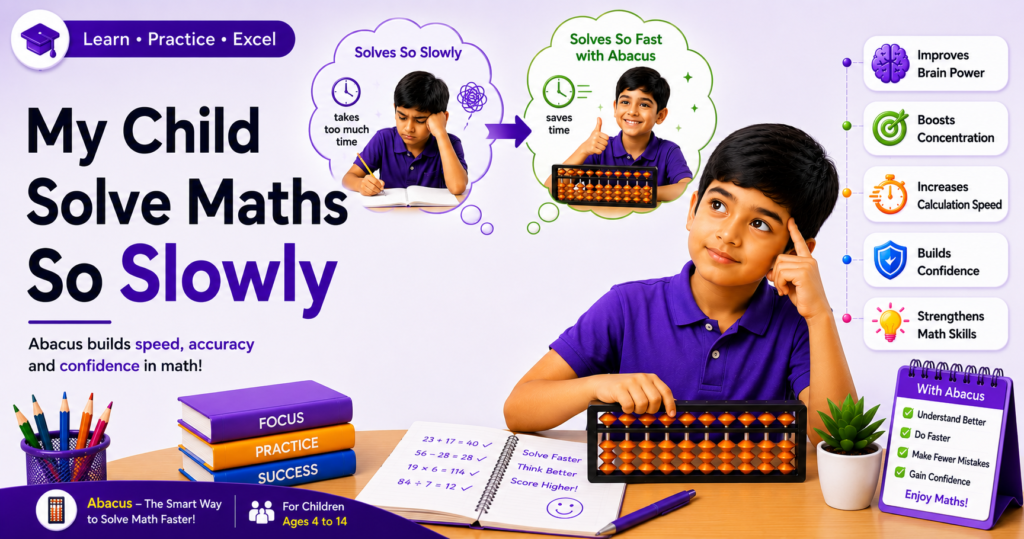
Every parent wants to see their child complete maths homework with confidence. But what happens when your child understands the lesson, knows the formulas, and still takes much longer than others to solve even simple problems? Watching them spend extra time on every calculation can be frustrating for both the child and the parent.
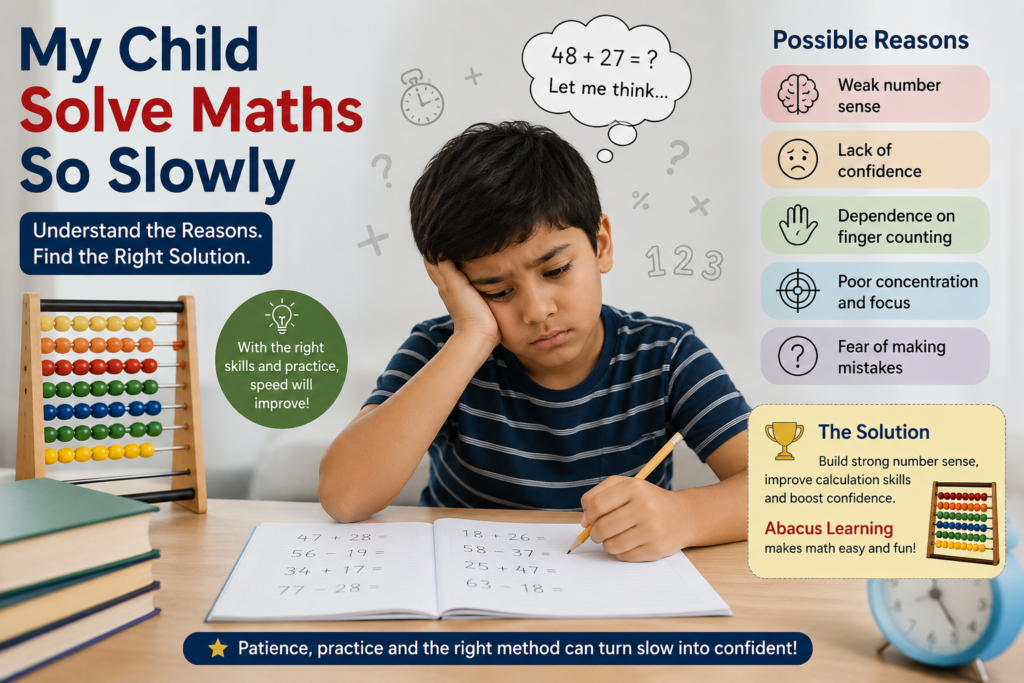
If you’ve ever found yourself thinking, My Child Solve Maths So Slowly, you’re certainly not alone. This is one of the most common concerns parents have during their child’s school years. The good news is that solving maths slowly doesn’t always mean a child is weak in mathematics. In many cases, children simply need to develop a stronger understanding of numbers, improve their calculation skills, and gain confidence while solving maths problems.
The right learning approach can help children become faster without sacrificing accuracy. Instead of encouraging them to rush, parents should focus on developing the skills that naturally improve speed over time. One proven method that supports this process is abacus training, which helps children understand numbers more clearly while making calculations easier and more enjoyable.
My Child Solve Maths So Slowly
Many parents believe that spending more time on maths automatically means their child isn’t good at the subject. However, that’s not always true.
Some children are naturally careful thinkers. They like checking every step before writing an answer. Others understand the concept but struggle to process numbers quickly. There are also children who depend heavily on finger counting or repeatedly calculate the same question because they don’t trust their first answer.
These habits make mathematics feel slow and tiring, even though the child is capable of learning.
Before looking for solutions, it’s important to understand why your child is taking longer than expected.
Why Does Your Child Take More Time to Solve Maths?
Every child learns differently.
Some children quickly recognize number patterns, while others need extra time to understand how numbers relate to one another. Neither approach reflects intelligence. It simply shows that children develop mathematical skills at different speeds.
Several factors can contribute to this challenge.
Weak Number Sense
Number sense is the ability to understand numbers naturally.
Children with strong number sense instantly recognize simple calculations and patterns. Those with weaker number sense often solve every problem one step at a time.
For example, instead of immediately knowing that 8 + 7 equals 15, they may count each number individually.
This slows down every calculation and makes longer problems even more challenging.
Lack of Confidence
Confidence plays a bigger role in mathematics than many parents realize.
Children who have made repeated mistakes often begin doubting themselves.
Instead of trusting their thinking, they stop after every step to check their answers again and again.
Many parents who say, My Child Solve Maths So Slowly, later discover that hesitation not ability is the real reason behind the delay.
Depending on Finger Counting
Finger counting is a natural stage in early maths learning.
However, if children continue depending on their fingers for basic calculations as they grow older, solving maths becomes increasingly slow.
As school mathematics becomes more advanced, children need faster mental calculation skills to keep up with classroom activities and examinations.
Helping children move beyond finger counting can make a significant difference in both speed and confidence.
My Child Solve Maths So Slowly
Another reason children solve maths slowly is that they focus so much on avoiding mistakes that they overthink every question.
Being careful is a good habit, but excessive checking often creates unnecessary delays.
Children who believe every answer might be wrong spend extra time verifying calculations instead of trusting the skills they already have.
With regular practice and encouragement, they gradually become more confident and begin solving questions more naturally.
Signs That Your Child Needs Additional Support
Sometimes children don’t openly say they are struggling.
Instead, their behaviour gives parents important clues.
Watch for these common signs:
- They take much longer than classmates to finish maths homework.
- They frequently count on their fingers.
- They leave maths exam questions unanswered because time runs out.
- They become anxious during timed classroom activities.
- They avoid practising maths whenever possible.
- They lose confidence after making simple calculation mistakes.
Recognizing these signs early allows parents to provide support before frustration becomes a long-term habit.
My Child Solve Maths So Slowly
One of the biggest mistakes parents make is asking children to complete more worksheets.
Although practice is important, practising the same mistakes repeatedly rarely improves speed.
Children first need to understand numbers in a meaningful way.
Once they begin recognizing patterns and relationships between numbers, calculations become much easier and faster.
Quality practice is always more valuable than simply completing a larger number of questions.
Why Speed Should Never Be the First Goal
It’s easy to compare your child’s speed with classmates.
However, mathematics is not a race.
A child who understands concepts properly will naturally become faster with regular practice.
On the other hand, pushing children to solve questions quickly before they understand the basics often increases stress and creates a fear of mathematics.
Parents should first focus on helping children develop confidence, logical thinking, and strong number foundations.
Speed follows naturally when understanding improves.
How Abacus Builds Faster Thinking
One of the biggest advantages of abacus training is that it teaches children to understand numbers instead of memorizing answers.
As children practise regularly, they begin visualizing numbers mentally rather than relying on finger counting or repeated calculations.
This approach strengthens concentration, improves accuracy, and gradually increases solving speed without making children feel pressured.
Many parents searching for My Child Solve Maths So Slowly discover that improving number sense is often the missing piece their child needs not simply more homework or longer study hours.
How Parents Can Help Children Improve Their Maths Speed
Improving calculation speed doesn’t happen overnight. Like any other skill, it develops through consistent practice, encouragement, and the right learning methods.
If you’ve ever thought, My Child Solve Maths So Slowly, remember that your support at home plays an important role in your child’s progress.
Here are a few practical ways parents can help:
- Encourage short daily maths practice instead of long study sessions.
- Focus on understanding rather than memorising answers.
- Celebrate small improvements to build confidence.
- Avoid comparing your child with other children, as every child learns at their own pace.
- Allow your child enough time to think without creating unnecessary pressure.
Children learn best when they feel supported rather than judged.
My Child Solve Maths So Slowly
One of the biggest misconceptions is that giving children more worksheets will automatically make them faster.
In reality, speed comes from understanding numbers, recognising patterns, and developing confidence.
When children repeatedly practise without strengthening their basic number skills, they often become frustrated instead of improving.
Helping children build a strong mathematical foundation is always more effective than simply increasing the amount of homework.
How Abacus Helps Children Solve Maths Faster
Abacus training develops the skills that children need to calculate quickly and accurately.
Instead of depending on finger counting or guessing answers, children learn to visualise numbers and perform calculations mentally.
With regular abacus learning, children gradually become more comfortable working with numbers. As their confidence grows, they begin solving problems faster without feeling rushed.
Parents who search for My Child Solve Maths So Slowly are often surprised to discover that improving number sense naturally leads to better speed and greater accuracy.
Why Confidence Is Just as Important as Speed
Children who constantly worry about making mistakes usually take longer to complete every question.
Fear slows down thinking.
Confidence speeds it up.
When children believe they can solve maths problems correctly, they stop second-guessing themselves and begin trusting their own abilities.
Many parents notice that My Child Solve Maths So Slowly becomes less of a concern once their child starts enjoying mathematics instead of fearing it.
Choosing the Right Learning Environment
Every child deserves an environment where learning feels positive and encouraging.
When looking for the best abacus classes in India, parents should choose programmes that focus on conceptual understanding rather than memorisation.
Experienced instructors encourage children to think independently, practise consistently, and develop confidence at their own pace.
Many parents also compare different mental math classes, but programmes that begin by strengthening number sense often provide more lasting improvements.
If you’re exploring abacus classes for kids, look for structured lessons, qualified trainers, and regular progress assessments that help children grow step by step.
Small Improvements Create Big Results
Progress in mathematics doesn’t always happen immediately.
A child who solves one question a little faster today may solve an entire worksheet more confidently a few months later.
Parents often begin noticing improvements such as:
- Faster basic calculations.
- Better concentration.
- Reduced finger counting.
- Greater confidence during class.
- Improved accuracy in school exams.
Families searching for My Child Solve Maths So Slowly often discover that these small improvements gradually lead to stronger academic performance.
Consistent practice always produces better results than occasional intensive study sessions.
Building Skills That Last Beyond School
Abacus is not only about improving calculation speed.
Regular practice supports brain development for children by strengthening concentration, visualization, memory, and logical thinking.
These abilities help children perform better across different subjects while becoming more confident learners.
Parents looking for the best abacus classes in India often choose programmes that focus on overall skill development rather than exam preparation alone.
Many of the best abacus classes in India help children become independent thinkers who enjoy solving problems instead of avoiding them.
As these skills develop, My Child My Child Solve Maths So Slowly gradually becomes a concern of the past.
Conclusion
If you’ve been thinking, My Child Solve Maths So Slowly, don’t assume your child lacks ability. Many children simply need stronger number sense, better calculation strategies, and greater confidence to improve their speed. With patient guidance, consistent practice, and the right learning approach, every child can become faster and more accurate in mathematics. Abacus training helps children develop these essential skills while making maths enjoyable and less stressful. Every child learns at their own pace, and with the right support, success in mathematics is well within reach.