
How to Overcome Maths Anxiety in Children: Practical Tips for Parents
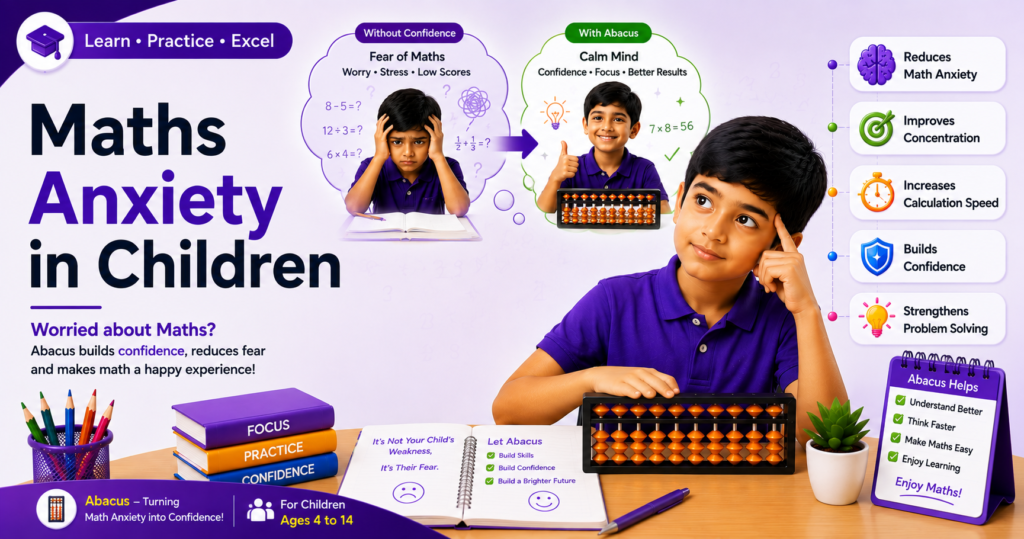
Have you noticed your child becoming nervous whenever maths homework begins? Maybe they understand a topic in class but suddenly say, “I can’t do this,” when they sit down to practise. Some children avoid maths altogether, while others become upset when they make even a small mistake.
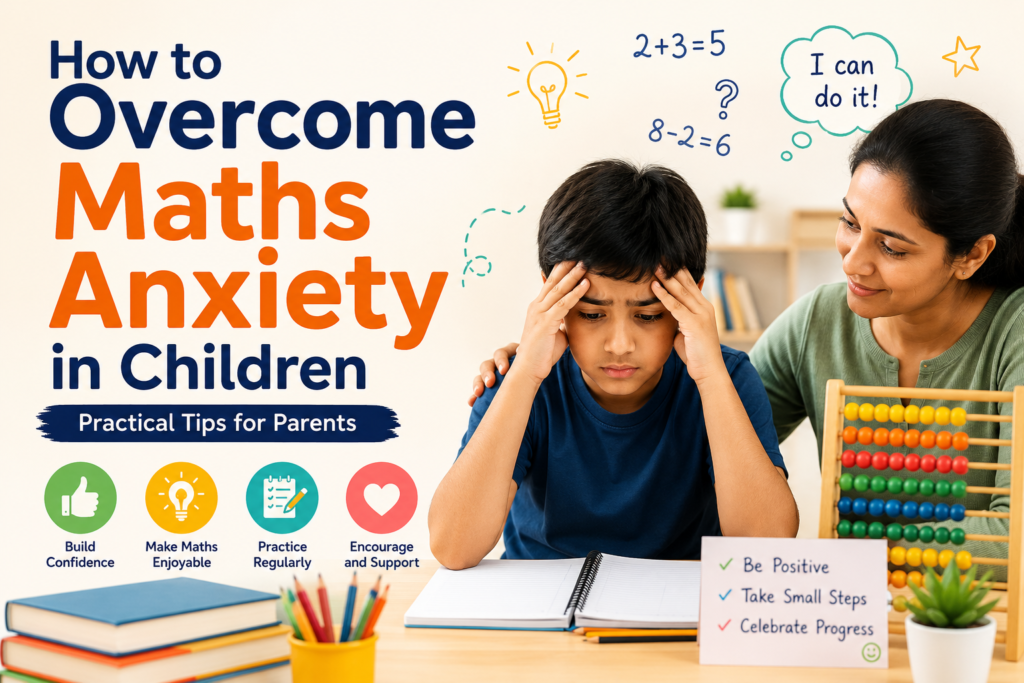
If your child reacts this way to maths, Maths Anxiety in Children may be affecting their confidence and willingness to try. It does not necessarily mean your child is weak in mathematics. Fear of mistakes, exam pressure, difficult past experiences, or a lack of confidence can all make maths feel much harder than it really is.
The good news is that confidence can be rebuilt. Children need patience, encouragement, and opportunities to experience success without feeling that every answer has to be perfect. A structured approach such as abacus training can also help children become more comfortable with numbers through regular, gradual practice.
What Does Maths Anxiety in Children Look Like?
Not every child shows anxiety in the same way. One child may openly say, “I hate maths,” while another may quietly avoid homework until the last possible moment.
Parents may notice that their child:
- Takes a long time to begin maths homework
- Becomes upset over simple calculations
- Says they are “bad at maths”
- Gets nervous before tests
- Frequently asks for help
- Gives up quickly when a question looks difficult
- Keeps checking answers because they are afraid of mistakes
- Compares their performance with classmates
- Forgets methods they previously understood
One difficult maths lesson does not automatically mean there is a problem. However, if these behaviours happen repeatedly, it is worth looking at how your child feels about mathematics rather than focusing only on marks.
For parents dealing with Maths Anxiety in Children, recognising these signs early can make it easier to understand what their child needs.
Why Does Maths Anxiety in Children Develop?
There is rarely one single reason. Children can develop negative feelings about maths for several different reasons, and understanding those reasons is an important first step.
Fear of Making Mistakes
Mistakes are a normal part of learning. Some children may start believing that getting an answer wrong means they are simply not good at maths.
They may erase their work repeatedly, hesitate before writing an answer, or keep asking, “Is this correct?”
When fear of making mistakes takes over, children may struggle to think clearly and work through the problem.
Too Much Pressure to Be Fast
Speed is useful in mathematics, especially during timed tests. But expecting children to work quickly before they are comfortable with the basics can create unnecessary stress.
Imagine a child who is still thinking carefully about a simple addition problem while hearing, “Hurry up!” Instead of focusing on the numbers, the child starts thinking about how slowly they are working.
That pressure can make the problem even harder.
Comparing Children With Others
Children notice when classmates finish before them.
Comments such as “Why can’t you do it like your friend?” may seem harmless, but they can affect confidence over time.
Rather than comparing your child with someone else, look at their own progress. If they can solve something today that they struggled with last month, that is meaningful improvement.
For some children, Maths Anxiety in Children begins after several experiences where they feel they are always falling behind others.
Simple Ways to Help With Maths Anxiety in Children
Parents do not need to become teachers to support their children. Small changes at home can make maths feel much safer and more manageable.
Use Positive Language
Children often remember the way adults talk about their abilities.
Try to avoid statements such as:
- “You are weak in maths.”
- “This is so easy. Why don’t you understand?”
- “You should already know this.”
- “Your friend is much better at maths.”
Instead, try saying:
- “Let’s work through it together.”
- “It’s okay if you don’t know it yet.”
- “Which part is confusing?”
- “Let’s try another way.”
This tells children that difficulty is temporary and that they are capable of improving.
Give Them Time to Think
Some children simply need a few extra seconds before answering.
If your child doesn’t answer immediately, don’t rush to give them the solution. Give a small clue instead.
For example, if they are struggling with 8 + 7, ask, “Can we make 8 into 10?” This encourages the child to think rather than depend on someone else for every answer.
Keep Practice Short
Long practice sessions can be exhausting, especially when a child already feels nervous about maths.
Try short, regular sessions instead. Ten or fifteen minutes of focused practice can be much easier for a child to manage than an hour of frustration.
The aim is to build a routine that feels achievable.
Celebrate Small Improvements
Don’t wait for a perfect exam score before praising your child.
Maybe they solved a problem without help. Perhaps they stopped using their fingers for a calculation. Or maybe they attempted a difficult question instead of giving up.
These small achievements matter.
For a child experiencing Maths Anxiety in Children, noticing progress can gradually replace the feeling of “I can’t do maths” with “I’m getting better at this.”
How Abacus Can Support Maths Anxiety in Children
Abacus training gives children regular opportunities to work with numbers in a structured way. Instead of immediately facing complicated calculations, they gradually practise skills at an appropriate level.
For some children, this familiarity can make numbers feel less intimidating.
As children practise, they learn to recognise number relationships and perform calculations more confidently. Over time, they may rely less on finger counting and become more comfortable working mentally.
This can be particularly useful when Maths Anxiety in Children is connected to hesitation during basic calculations.
However, abacus should not be treated as a magic solution. Children learn differently, and the quality of teaching matters. A patient instructor who allows children to make mistakes and learn at their own pacecancreatea muchmore positive experience.
The goal should be confidence first, followed by speed and accuracy.
Make Maths Part of Everyday Life
Maths does not always have to happen with a workbook.
There are many simple ways to bring numbers into everyday activities.
While shopping, ask your child to estimate the total cost of two items. When cooking, let them measure ingredients. During a journey, ask how long it might take to reach the destination. At home, they can divide snacks equally among family members.
These activities help children see that mathematics is useful outside school.
They also remove some of the pressure that comes with a traditional worksheet.
Parents supporting Maths Anxiety in Children can use these everyday activities to create positive experiences with numbers without making the child feel like they are sitting for another lesson.
Build Confidence Before Expecting Better Marks
When children struggle with maths, parents naturally want their marks to improve. But confidence often needs to come first.
A child who thinks, “I’ll never get this right,” may give up before trying. A child who thinks, “This is difficult, but I’ll try step by step,” is much more likely to keep going.
This change does not happen overnight.
Give your child opportunities to experience small successes. Over time, those moments can change the way they think about themselves as maths learners.
For many families dealing with Maths Anxiety in Children, this shift in attitude can be just as important as improving calculation skills.
What Parents Should Avoid
Sometimes parents unintentionally increase a child’s stress.
Avoid forcing your child to continue working when they are already frustrated. A short break can help them return with a clearer mind.
Try not to make marks the only measure of progress. School performance is important, but it does not always show the whole picture.
Also, avoid solving every problem for your child. If they are stuck, ask a guiding question or give a small hint instead of immediately giving the answer.
Most importantly, don’t label your child as a “weak maths student.”
Children can improve.
A child who struggles with fractions today may become comfortable with them after receiving the right support and enough practice.
When Should Parents Consider Extra Support?
If your child continues to feel very nervous about maths despite encouragement and regular practice, additional support may be useful.
Start by speaking with the child’s teacher. Try to find out whether there are particular areas where your child is struggling.
Sometimes anxiety develops because of a gap in basic skills. For example, a child who is not comfortable with multiplication may later find division difficult. Similarly, weak understanding of fractions can make more advanced topics confusing.
Finding the underlying difficulty is often more helpful than simply giving the child additional worksheets.
When Maths Anxiety in Children continues for a long time, understanding the specific cause can help parents and teachers choose a more suitable learning approach.
Helping Children Develop a Positive Maths Mindset
The long-term goal is not to make your child perfect at maths.
It is to help them believe that they can learn maths.
Children need to understand that some questions will be easy and others will require more effort. That is completely normal.
When a child becomes comfortable saying, “I don’t understand this yet,” they are already developing a healthier approach to learning.
With consistent encouragement and suitable practice, their relationship with mathematics can gradually become more positive.
Conclusion
If your child is dealing with Maths Anxiety in Children, don’t assume that they lack mathematical ability. Fear can make familiar questions seem much more difficult. Reducing pressure, avoiding comparisons, celebrating small improvements, and giving children time to think can make a real difference.
For parents considering extra support, choosing best abacus classes in India can be a useful step when the programme offers patient guidance and regular practice. Abacus classes for kids can introduce numbers in a structured and engaging way, while mental math classes can help children become more comfortable with calculations. Consistent abacus learning may also support skills such as concentration, confidence, and number understanding, while activities that encourage brain development for children can contribute to broader learning abilities.
Most importantly, children need to know that struggling with maths today does not mean they will struggle forever. With patience, encouragement, and the right learning environment, confidence can grow step by step.