
Why Does My Child Need More Time for Maths?
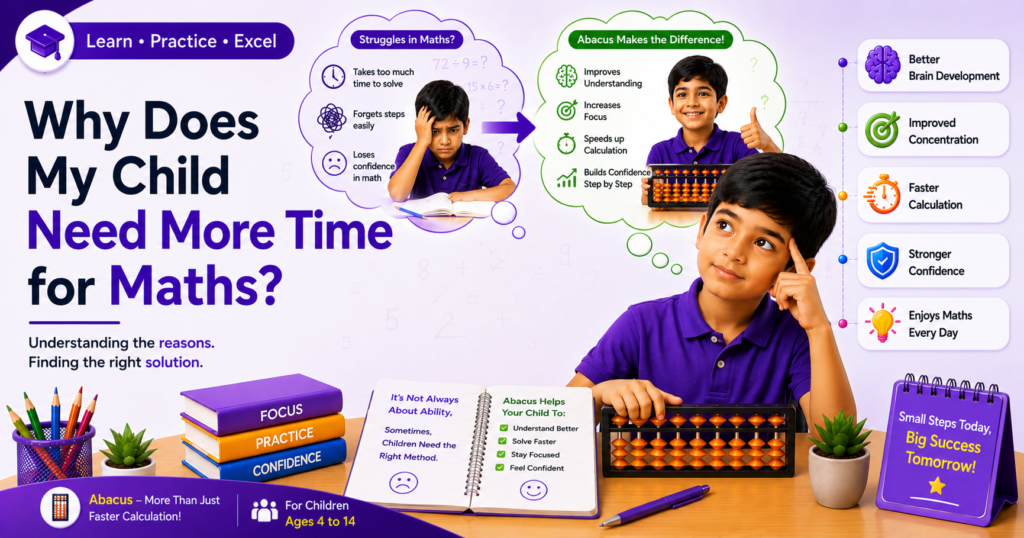
Does your child understand a maths lesson but still take much longer than expected to finish the questions? Maybe homework that should take 20 minutes stretches into an hour, or your child runs out of time during school tests. If you have been wondering, Why Does My Child Need More Time for Maths?, it is important to know that taking longer does not automatically mean your child is weak in mathematics. Children develop calculation speed and confidence at different rates, and several learning habits can affect how quickly they solve problems.
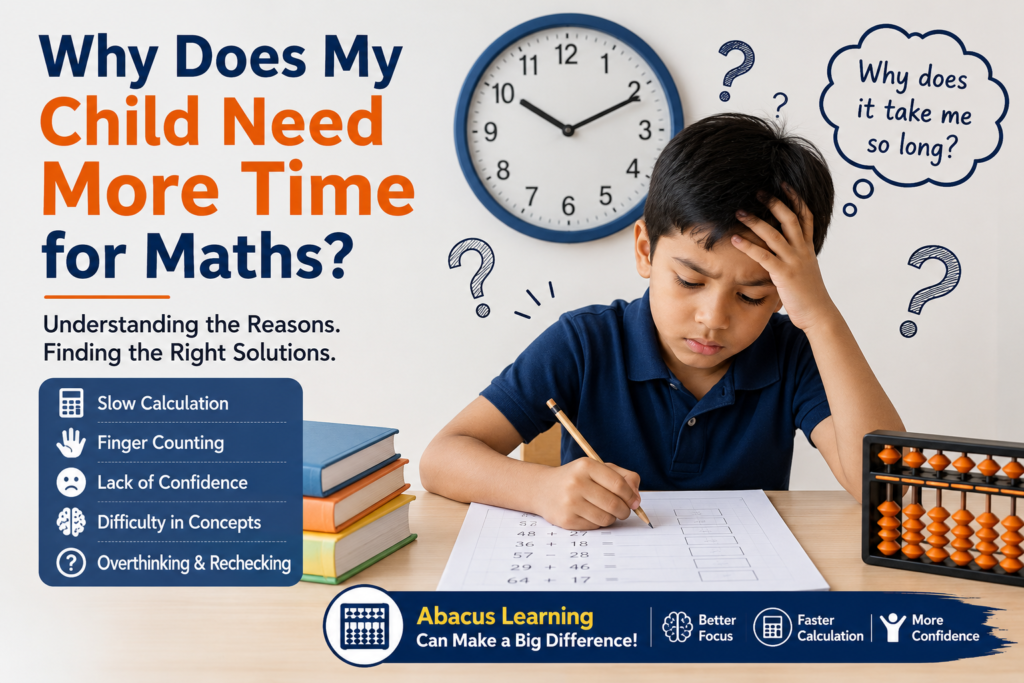
Sometimes the issue is a weak foundation in basic number skills. In other cases, children may hesitate because they are afraid of making mistakes, depend on finger counting, or spend too much time checking every step. With the right support, these habits can gradually change. The goal is not to pressure children to work faster, but to help them become comfortable enough with numbers that speed develops naturally.
Why Does My Child Need More Time for Maths?
Before trying to increase a child’s speed, parents should understand what is slowing them down. Every child approaches mathematics differently. Some children quickly recognise number patterns, while others prefer to work through each calculation carefully.
A slower pace can actually show that a child is trying to understand the problem properly. The concern arises when the child consistently needs excessive time for simple calculations, struggles to complete classwork, or becomes anxious whenever a time limit is involved.
If you are asking, Why Does My Child Need More Time for Maths?, look beyond the clock. Understanding the reason behind the slow pace is much more useful than simply asking your child to hurry.
Common Reasons Children Take Longer to Solve Maths Problems
Weak Number Sense
Number sense helps children understand how numbers relate to one another. A child with strong number sense can often recognise simple combinations without calculating everything from the beginning.
For example, a child may quickly recognise that 7 + 8 equals 15. Another child may count from 7 to reach the answer. Both children may understand addition, but the second child needs more time because the calculation involves extra mental steps.
Strengthening number sense can therefore make everyday calculations much smoother.
Dependence on Finger Counting
Finger counting is a normal part of early mathematical development. However, when children continue relying on their fingers for basic calculations as they progress through school, it can become a barrier to faster mental calculation.
A child who counts each number manually may struggle when calculations become larger or more complex.
Moving gradually from physical counting to mental strategies can help children become more independent with numbers.
Lack of Confidence
Confidence has a direct effect on how children approach mathematics.
A child who is worried about getting an answer wrong may solve a simple question, stop, check it again, and then check it one more time. This cautious approach can make even familiar calculations take much longer.
If you keep thinking, Why Does My Child Need More Time for Maths?, consider whether hesitation is part of the problem.
Building confidence does not mean telling children that every answer is correct. It means helping them understand mistakes, learn from them, and trust their own reasoning.
Why Does My Child Need More Time for Maths?
Overthinking Simple Calculations
Some children know the answer but still take too long because they overthink the process.
They may remember several methods for solving the same problem and become unsure about which one to use. Others may spend too much time checking basic calculations.
This is often seen in children who are afraid of making mistakes.
Instead of saying, “Why are you so slow?”, parents can ask, “Which part of this question takes the most time?” This small change can help parents understand what their child is actually struggling with.
Gaps in Basic Maths Skills
A child may struggle with multiplication facts, place value, addition, subtraction, or number relationships. When these basic skills are not automatic, every new topic requires extra mental effort.
For example, a child who still needs to work out simple multiplication facts may take longer to solve fractions or word problems later.
Strong foundations matter because advanced mathematics builds on earlier skills.
Difficulty Understanding the Question
Sometimes the calculation itself is not the problem.
A child may read a word problem several times because they are unsure what information is important or what the question is actually asking.
In such cases, improving reading comprehension, identifying key information, and breaking a problem into smaller steps can make mathematics easier.
How Can Parents Help a Child Who Needs More Time?
If you are still wondering, Why Does My Child Need More Time for Maths?, avoid immediately increasing the amount of homework.
More worksheets are not always the answer.
Instead, parents can make practice shorter, more focused, and consistent. Ten to fifteen minutes of purposeful practice each day can be more useful than a long session once a week.
Parents can also:
- Practise basic calculations regularly.
- Encourage children to explain how they found an answer.
- Use everyday situations such as shopping or measuring for simple maths practice.
- Celebrate improvement instead of comparing speed with other children.
- Give children enough time to think before correcting them.
- Encourage mental calculation gradually.
The aim should be steady progress, not instant speed.
How Abacus Can Help Improve Calculation Speed
Abacus training gives children a structured way to work with numbers. Instead of relying entirely on written calculations or finger counting, children learn to represent numbers using an abacus and gradually develop mental visualisation skills.
With regular abacus learning, children practise calculations repeatedly while developing concentration, accuracy, and confidence.
The physical abacus provides a visual and hands-on starting point. As children become familiar with it, they can gradually begin imagining the beads mentally while calculating.
This transition from physical movement to mental visualisation can help make calculations feel more natural.
Building Speed Without Creating Pressure
Speedshould never be forced.
When children are repeatedly told to “do it faster,” they may become nervous and make more mistakes. A better approach is to develop accuracy first and allow speed to follow.
Structured practice can give children repeated opportunities to work with numbers in a supportive environment. Over time, familiar calculations require less conscious effort.
That is particularly useful for children who often ask, Why Does My Child Need More Time for Maths?
Choosing the Right Support for Your Child
Not every child needs the same type of mathematical support. Some may benefit from additional school practice, while others may respond well to structured programmes.
Parents considering abacus classes for kids should look for programmes that provide age-appropriate instruction, regular practice, and encouragement rather than focusing only on speed.
The quality of teaching matters. A good instructor should understand that children progress differently and should help them build skills step by step.
When comparing best abacus classes in India, parents can look at factors such as teaching methods, trainer experience, class structure, student progress, and the level of individual attention provided.
Similarly, mental math classes may be useful for children who are ready to work more extensively with numbers mentally. The important thing is to choose an approach that matches the child’s current ability.
Why Understanding Matters More Than Speed
A fast answer is not useful if the child does not understand how it was reached.
Parents should therefore avoid making speed the only measure of progress.
A child who initially takes ten minutes to complete a set of questions but gradually reduces that time while maintaining accuracy is making meaningful progress.
The same child may eventually become much faster as the underlying skills become stronger.
This is why, when parents ask, Why Does My Child Need More Time for Maths?, the answer should not simply be “because they need more practice.” The type of practice, the child’s confidence, and the strength of their foundations all matter.
Building Confidence Through Everyday Practice
Children do not need complicated activities every day to become better at mathematics.
Simple activities can help:
- Ask children to calculate small shopping totals.
- Let them estimate quantities while cooking.
- Practise quick addition during daily routines.
- Encourage them to explain their reasoning.
- Use games that involve numbers and patterns.
- Give them opportunities to solve problems without immediately providing the answer.
These activities make numbers part of everyday life instead of something children only encounter in textbooks.
For some children, this kind of relaxed practice can make mathematics feel much less intimidating.
What Progress Should Parents Expect?
Every child develops at a different pace, so there is no fixed timeline for becoming faster at maths.
Parents may first notice small changes. A child might stop using fingers for simple sums, make fewer calculation mistakes, or become more willing to attempt difficult questions.
Later, they may complete familiar calculations more quickly and feel more comfortable during timed activities.
These changes may appear gradually rather than all at once.
Parents who ask, Why Does My Child Need More Time for Maths?, should therefore look at overall progress instead of comparing their child with classmates.
Creating a Positive Maths Environment at Home
The atmosphere at home can make a significant difference.
If every maths session ends with criticism, children may begin associating numbers with stress. If parents focus on effort, improvement, and problem-solving, children are more likely to stay engaged.
This does not mean ignoring difficulties. It means addressing them calmly.
A child who feels safe making mistakes is more likely to try different strategies, ask questions, and keep practising.
Developing confidence, concentration, visualisation, and logical thinking can also support brain development for children, making these skills valuable beyond mathematics.
Conclusion
If you are asking, Why Does My Child Need More Time for Maths?, remember that a slower pace does not define your child’s ability or intelligence. Weak number sense, finger counting, gaps in basic skills, hesitation, and lack of confidence can all affect calculation speed. The good news is that these skills can be strengthened with patient guidance and consistent practice. Abacus training can provide children with a structured way to improve number understanding, mental calculation, concentration, and confidence. With the right support and realistic expectations, children can gradually become more comfortable with numbers and complete maths tasks with greater ease.