
Why Does My Child Avoid Maths Homework?
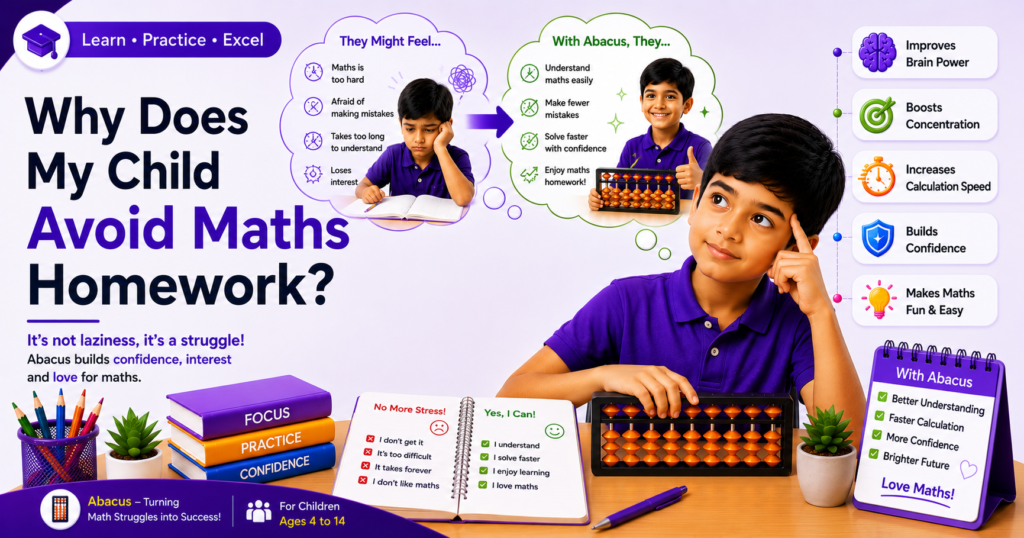
Does your child suddenly find something else to do whenever it is time to open the maths book? Do they complain that the work is too difficult, get distracted, or keep asking to take a break? If you have ever wondered, Why Does My Child Avoid Maths Homework?, the reason may be more than simple laziness. Children can avoid maths homework when they feel confused, lack confidence, find calculations tiring, or have developed negative feelings about the subject.
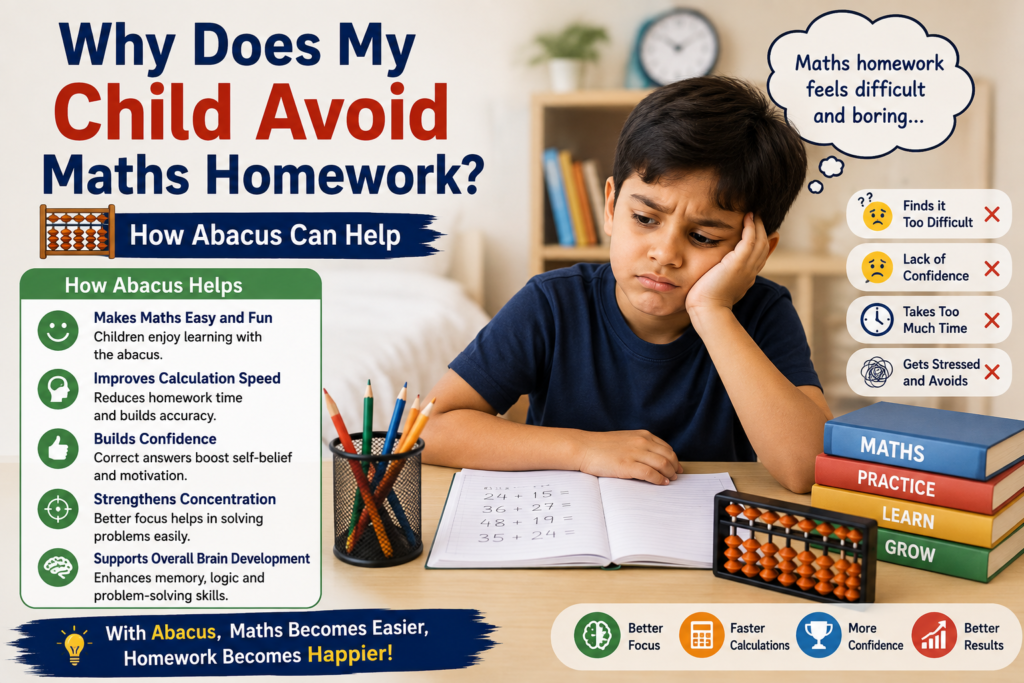
Homework is meant to reinforce what children learn in school, but it can become stressful when a child feels that every question is a struggle. Instead of forcing them to sit for longer hours, parents need to understand what is making maths feel difficult in the first place. Once the underlying problem is identified, the right support can make practice more comfortable and productive.
Why Does My Child Avoid Maths Homework?
There is rarely just one reason a child avoids mathematics. Every child has a different learning style, and their behaviour can change depending on their experience with the subject.
Some children avoid homework because they don’t understand the lesson. Others may understand the concept but take too long to complete calculations. Some worry about making mistakes, while others simply find maths less enjoyable than their favourite subjects.
If you are asking, Why Does My Child Avoid Maths Homework?, start by observing what happens when homework begins. Does your child immediately say, “I don’t know”? Do they become frustrated after the first few questions? Do they repeatedly ask for help with simple calculations?
These small clues can reveal what is really happening.
Common Reasons Children Avoid Maths Homework
They Don’t Understand the Basics
When a child has missed an important concept, later lessons can become increasingly difficult.
For example, difficulty with addition and subtraction can eventually affect multiplication, division, fractions, and word problems. The child may not know exactly where the problem started, but they know that maths feels difficult.
As a result, avoiding homework becomes an easy way to avoid that uncomfortable feeling.
They Are Afraid of Making Mistakes
Some children become very sensitive to mistakes, particularly if they have previously been corrected frequently.
They may spend a long time checking simple answers because they are worried about getting something wrong. Eventually, maths homework begins to feel like a test rather than an opportunity to learn.
If you are wondering, Why Does My Child Avoid Maths Homework?, consider whether fear of mistakes is playing a role.
Children need to understand that mistakes are a normal part of learning. A wrong answer can show exactly which concept needs more practice.
They Find Calculations Too Slow
A child may understand a maths problem but still need a lot of time to calculate the answer.
When every question requires several steps, even a short worksheet can feel exhausting.
This is particularly common when children depend heavily on finger counting or have not yet developed strong number sense.
When maths feels physically and mentally tiring, children may start avoiding homework simply because they expect it to take too long.
Why Does My Child Avoid Maths Homework?
They Don’t Feel Confident With Numbers
Confidence can completely change how a child approaches mathematics.
A confident child is more likely to attempt a difficult question, try another method, and correct a mistake. A child who lacks confidence may stop before even trying.
Parents sometimes notice that a child who performs well in other subjects becomes unusually quiet or frustrated when mathematics appears.
This does not necessarily mean the child cannot learn maths. It may mean they need more encouragement and a learning approach that helps them experience small successes.
Maths Homework Feels Like a Long Task
Children naturally prefer activities that give them immediate enjoyment.
If maths homework consists of a large number of repetitive questions, children may lose interest before they finish.
Instead of asking a child to complete everything in one sitting, parents can divide the work into smaller sections. A short break between activities can make the task feel much more manageable.
The goal is to create a routine where maths becomes part of the day rather than a major source of stress.
How Parents Can Make Maths Homework Easier
If you are still asking, Why Does My Child Avoid Maths Homework?, changing the home environment can make a noticeable difference.
Start by choosing a consistent time and a quiet place for homework. Keep distractions such as television and unnecessary phone use away during the study period.
Parents should also avoid sitting over the child throughout every question. Being available for support is helpful, but children also need opportunities to think independently.
Try asking questions such as:
- “What do you understand about this question?”
- “Which part is confusing you?”
- “Can you show me how you started?”
- “Is there another way to solve it?”
These questions encourage children to think instead of simply waiting for the answer.
Keep Practice Short and Consistent
Long study sessions can make children even more resistant to maths.
Short, regular practice is usually easier to maintain. A child may be more willing to spend 15 minutes practising calculations than an entire hour completing a large worksheet.
Parents can also include maths in everyday situations. Asking children to calculate a shopping total, compare prices, measure ingredients, or work out simple quantities can make numbers feel more relevant.
When mathematics becomes part of daily life, it doesn’t always feel like formal homework.
How Abacus Can Help Children Enjoy Maths
Abacus training provides children with a hands-on way to work with numbers. Instead of depending entirely on written calculations, children learn to represent numbers using an abacus and gradually develop mental calculation skills.
With regular abacus learning, children practise calculations in a structured way while working on accuracy, concentration, and confidence.
The visual nature of the abacus can make numbers easier for younglearners to understand. Over time, children can begin visualising the beads mentally and perform calculations without physically using the tool.
This can be especially helpful for children who find basic calculations tiring or repetitive.
Why Does My Child Avoid Maths Homework?
When children begin feeling more comfortable with calculations, homework can become less intimidating.
A question that previously required several minutes may become easier because the child has developed stronger number relationships and calculation habits.
Abacus should not be viewed as a shortcut that makes every maths problem instantly easy. Rather, it provides regular practice that can strengthen important foundational skills.
The improvement usually comes gradually through consistent learning and encouragement.
Building a Positive Attitude Towards Mathematics
Parents have a powerful influence on how children feel about maths.
If children regularly hear that maths is difficult, boring, or stressful, they may start believing it themselves. On the other hand, calm encouragement can help them see challenges as something they can work through.
When children ask for help, avoid saying, “This is easy. Why don’t you understand it?”
Instead, try:
“Let’s look at it together and find which part is difficult.”
That small change can make children feel supported rather than judged.
If you are thinking, Why Does My Child Avoid Maths Homework?, remember that emotional support can be just as important as academic practice.
Choosing the Right Learning Support
If your child continues to struggle despite regular practice, additional support may be useful.
Parents looking for abacus classes for kids should consider programmes that focus on understanding, regular practice, and confidence rather than simply pushing children to calculate faster.
The instructor’s approach matters. Children should feel comfortable asking questions and making mistakes while learning.
When comparing the best abacus classes in India, parents can consider teaching methods, trainer experience, class structure, practice routines, and how student progress is monitored.
The right learning environment can help children develop a more positive relationship with mathematics.
Don’t Compare Your Child With Others
Every child develops mathematical skills at a different pace.
Comparing your child with a sibling, friend, or classmate may create unnecessary pressure. A child who takes longer today may become much more confident with consistent support.
Instead of asking, “Why can’t you solve it as quickly as your friend?”, focus on personal progress.
Celebrate improvements such as completing a calculation independently, making fewer mistakes, or attempting a question without hesitation.
These small achievements build confidence over time.
Making Maths Less Stressful at Home
If you are still thinking, Why Does My Child Avoid Maths Homework?, look at the overall homework experience.
Is your child tired when they begin? Are they hungry? Is the study area noisy? Are they being asked to complete too many questions at once?
Sometimes a few simple changes can make homework much easier.
A comfortable routine, realistic expectations, short practice sessions, and positive encouragement can reduce resistance.
Parents can also use puzzles, number games, and practical activities to make learning more enjoyable.
The aim is not to turn every moment into a maths lesson. Children need time to relax and enjoy childhood too.
Why Confidence Matters More Than Finishing First
Parents naturally want their children to finish homework quickly, but speed should not be the only measure of success.
A child who understands a concept properly is building a stronger foundation than a child who rushes through questions without understanding them.
As confidence and calculation skills improve, speed can develop naturally.
This is why Why Does My Child Avoid Maths Homework? should not be answered simply by telling the child to “work harder.” The better question is: What can we change so maths feels easier and more achievable?
When children feel capable, they are more likely to practise willingly.
Supporting Long-Term Learning
Mathematics is not only about school marks. It develops reasoning, logical thinking, problem-solving, and everyday decision-making.
Structured activities that strengthen brain development for children can support skills that are useful across different areas of learning.
For some children, additional mental math classes may also provide useful practice in working with numbers without relying heavily on written steps.
The most important factor is consistency. A few minutes of meaningful practice every day can be more valuable than occasional long sessions filled with frustration.
Conclusion
If you are asking, Why Does My Child Avoid Maths Homework?, the answer may be hidden behind a lack of confidence, weak foundations, slow calculations, fear of mistakes, or simply feeling overwhelmed by long assignments. Instead of treating avoidance as laziness, parents can look for the reason behind the behaviour and provide the right kind of support. A calm home routine, focused practice, encouragement, and structured abacus training can help children become more comfortable with numbers. With patience and consistent guidance, maths homework can gradually become a learning activity that children approach with greater confidence rather than something they constantly try to escape.