
Abacus vs Calculator: Which Is Better for Children?
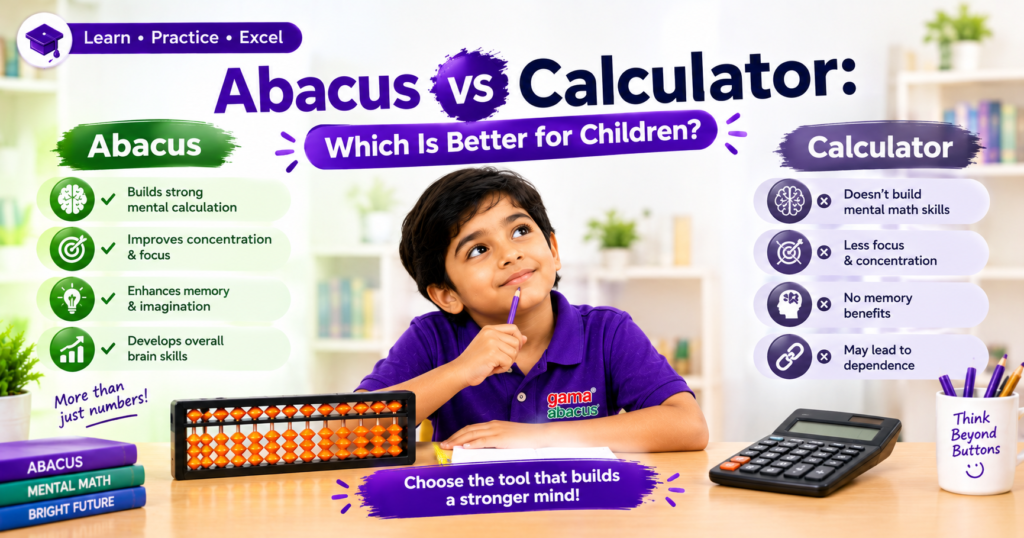
Abacus vs Calculator: Which Is Better for Children is a common question among parents who want to help their children develop strong mathematical skills. Both tools make calculations easier, but they serve different purposes in a child’s educational journey. A calculator provides quick answers, while an abacus allows children to explore numbers through physical movement, visual understanding, and regular practice.
Children today grow up surrounded by digital technology, and calculators are useful for solving numerical problems efficiently. However, learning mathematics involves more than finding the correct answer. Children also need to understand number relationships, practise arithmetic, and develop confidence in solving problems independently. When comparing Abacus vs Calculator: Which Is Better for Children, parents should consider the child’s age, learning ability, educational goals, and familiarity with mathematics.
Understanding these differences can help parents choose suitable learning activities and introduce technology at the right stage. Both tools have their advantages, and using them appropriately can support a balanced approach to mathematical education.
What Is an Abacus?
An abacus is a traditional counting and calculation tool consisting of beads arranged on rods within a frame. Each bead represents a numerical value, and moving the beads allows children to perform mathematical operations such as addition, subtraction, multiplication, and division. It provides a visual and hands-on way to explore numbers.
How Does an Abacus Work?
Children learn to represent numbers by moving beads into specific positions. For example, when calculating 12 + 5, a child first represents 12 on the abacus and then moves the appropriate beads to add 5. The resulting arrangement represents 17.
As children become familiar with bead movements and number combinations, they can gradually practise more challenging calculations. Some learners also develop the ability to imagine bead positions and perform calculations mentally. Progress depends on the child’s practice, instruction, and individual learning needs.
Benefits of Abacus Practice
Regular, structured abacus exercises provide opportunities for children to practise calculation fluency, number recognition, concentration, visualization, and accuracy. Children can review their bead movements to understand mistakes and learn how to correct them. These activities may also help learners become more comfortable when working with numbers.
What Is a Calculator?
A calculator is an electronic or digital device designed to perform mathematical operations quickly. Basic calculators handle addition, subtraction, multiplication, and division, while advanced models can perform calculations involving percentages, fractions, and scientific functions.
How Does a Calculator Work?
A calculator processes the numbers and operations entered by the user and displays the result. For example, entering 125 + 275 produces 400 almost immediately. This makes calculators useful for checking answers, working with large numbers, and completing complex calculations efficiently.
However, a calculator only provides the answer; children still need to understand how the calculation works and why the answer is correct. Children still need to understand the operation, recognise when a result is reasonable, and identify errors caused by entering incorrect numbers or selecting the wrong function.
Abacus vs Calculator: Which Is Better for Children?
The main difference between these tools is their purpose. An abacus encourages hands-on calculation practice, while a calculator automates much of the calculation process. An abacus helps children understand numbers and learn how calculations work. A calculator, on the other hand, is useful for getting quick answers and solving calculations efficiently.
When considering Abacus vs Calculator: Which Is Better for Children, parents should focus on the skills they want their children to develop rather than choosing a tool simply because it is faster. Understanding numbers and solving calculations quickly are both important, but each helps children develop different mathematical skills.
Number Understanding and Mathematical Foundations
Children benefit from understanding how numbers work before relying heavily on devices that provide answers automatically. An abacus represents numerical values through beads, allowing children to observe how quantities change during addition and subtraction. For example, adding three to five creates a visible representation of eight.
These hands-on activities can make basic arithmetic more concrete and engaging. A calculator becomes particularly useful once children understand the relevant operations and want to verify answers or work with larger numbers. Combining practical activities with clear explanations can help children develop a stronger foundation in mathematics.
For younger learners, Abacus vs Calculator: Which Is Better for Children depends partly on their current understanding. Children who are still learning to recognise numbers and perform simple calculations may benefit from hands-on activities before using calculators extensively.
Calculation Speed and Accuracy
Calculators generally produce answers faster than manual calculation methods, especially when dealing with large numbers or complex operations. An abacus requires learners to follow calculation procedures, but regular practice can help them become more familiar with number combinations and improve their calculation fluency.
Accuracy is equally important. A child may move beads incorrectly or forget a step, while a calculator user may enter the wrong number or select an incorrect operation. Both situations demonstrate why children should learn to review their work and estimate whether an answer makes sense.
In Abacus vs Calculator: Which Is Better for Children, the distinction is between practising the calculation process and completing calculations efficiently. Children need opportunities to develop both skills so that they can approach different mathematical tasks with confidence.
Concentration, Memory, and Visualization
Abacus exercises require children to follow bead movements, remember calculation steps, and pay attention to numerical changes. Mental abacus practice also encourages learners to imagine bead positions while solving problems. These activities provide opportunities to practise concentration, working memory, and visualization.
However, improvements vary between children, and benefits should not be assumed to transfer automatically to every academic subject. Appropriate instruction, regular practice, and a supportive learning environment are important for maintaining progress.
Calculators can also support focused learning activities. For instance, children can estimate an answer, solve the problem independently, and then use a calculator to check the result. This approach encourages them to think about the calculation rather than accepting every displayed answer without question.
Independent Thinking and Problem-Solving
Mathematics involves more than producingthe correct answer. Children need to understand questions, identify relevant information,choose appropriate operations, and explain theirreasoning. These skills are important when solving word problems and applying mathematical concepts to everyday situations.
An abacus encourages learners to work through calculation steps. When a mistake occurs, teachers can guide children to review their movements and identify where the error happened. A calculator, on the other hand, is valuable when children already understand the problem and need to verify a result or complete a complex computation.
The question of Abacus vs Calculator: Which Is Better for Children therefore depends on whether the goal is to practise foundational skills or perform calculations efficiently. Children should learn to choose a suitable tool while continuing to develop their own mathematical reasoning.
Which Tool Is Suitable for Different Age Groups?
Preschool and Early Primary School Children
Young children often benefit from hands-on activities such as counting objects, recognising numbers, and arranging beads. An abacus can introduce basic numerical concepts through interactive exercises. At this stage, the focus should be on understanding and enjoyment rather than calculation speed.
Primary School Children
As children learn addition, subtraction, multiplication, and division, structured abacus practice can provide additional opportunities to improve calculation fluency. They should also practise written methods, estimate answers, and explain their reasoning. Calculators can be introduced when they support a particular classroom activity or checking exercise.
Older Children
Older students encounter fractions, decimals, percentages, algebra, geometry, and more complex mathematical problems. Calculators can be valuable for checking calculations and handling operations that would otherwise take considerable time. Students should still understand mathematical concepts and show their working when required by their teachers.
Can Children Learn Both Tools?
Yes. Parents do not need to choose one tool exclusively. A balanced approach allows children to practise arithmetic while learning when technology is useful. For example, a child can solve an addition problem using an abacus, estimate the result mentally, and then use a calculator to check the answer. Comparing the results can help identify mistakes and reinforce number understanding.
Parents researching the best abacus classes in India can look for programmes that provide age-appropriate instruction, progressive exercises, constructive feedback, and opportunities for regular practice. Suitable abacus classes for kids should complement school mathematics rather than replace the wider curriculum.
Children still need to develop written calculation skills, measurement knowledge, and problem-solving abilities. Appropriate mental math classes can also give children opportunities to practise calculations without immediately depending on electronic devices.
How Can Parents Choose the Right Learning Approach?
Parents should consider their child’s current mathematical ability, learning preferences, and educational goals before selecting a learning approach. If a child is struggling with number recognition or basic arithmetic, activities that represent numbers visually may be helpful. If the child already understands the concepts and needs to check complex calculations, a calculator may be more appropriate.
Regular practice is also important. Short, manageable learning sessions can help children build familiarity without becoming overwhelmed. Parents should look for teaching methods that explain concepts clearly, provide constructive feedback, and allow children to progress at a suitable pace.
When comparing Abacus vs Calculator: Which Is Better for Children, parents should avoid focusing only on speed or comparing their child’s performance with that of other learners. Understanding, confidence, and steady progress are more meaningful goals.
How GAMA Abacus Supports Children’s Mathematical Learning
GAMA Abacus offers structured learning opportunities that help children practise arithmetic and become more familiar with numerical operations. Through guided activities and progressive exercises, learners can work towards improving calculation fluency, accuracy, and confidence.
When exploring abacus learning, parents should look for a programme that matches their child’s level, explains techniques clearly, encourages consistent practice, and provides appropriate feedback. A well-structured programme gives children time to learn each concept and progress when they are ready.
GAMA Abacus also offers online live classes, allowing children to participate in instructor-led sessions from home. Parents can enquire about available programmes, class formats, and suitable learning levels to determine which option meets their child’s needs.
Supporting brain development for children involves a variety of experiences, including mathematics, reading, creative activities, physical exercise, play, and meaningful interaction with others. Abacus practice can form one part of this broader learning environment.
Conclusion
Abacus vs Calculator: Which Is Better for Children depends on the child’s learning goals and current mathematical abilities. An abacus can help children explore numerical values, practise arithmetic, and develop mental calculation techniques. A calculator is useful for obtaining answers quickly, checking results, and completing complex computations.
For younger learners who are building mathematical foundations, an abacus can be a helpful educational tool when introduced through suitable instruction and regular practice. As children advance, calculators can become an important part of their mathematical toolkit. The two tools can complement each other when used for the right purposes.
Ultimately, Abacus vs Calculator: Which Is Better for Children? is about choosing the right tool for the task rather than declaring one universally superior. With balanced guidance, suitable practice, and realistic expectations, children can build confidence and become more independent learners. Contact GAMA Abacus to learn about available programmes and explore suitable learning options for your child.