
How Does GAMA Abacus Help Children Progress from Basic Arithmetic to Advanced Calculations?
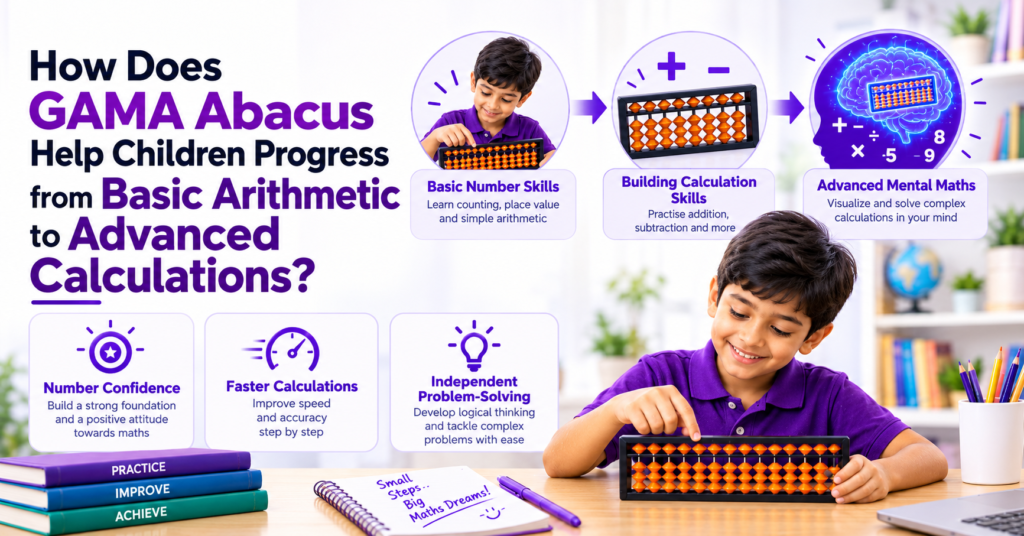
Every child starts learning mathematics somewhere. For some, adding small numbers is easy, while others need more time to understand how numbers work. As children move to larger numbers and more complicated sums, they may begin to wonder whether maths is becoming too difficult. This is where a structured learning approach can make a difference. Basic Arithmetic to Advanced Calculations is not a journey that happens overnight; children need time, practice, and guidance to develop their skills.
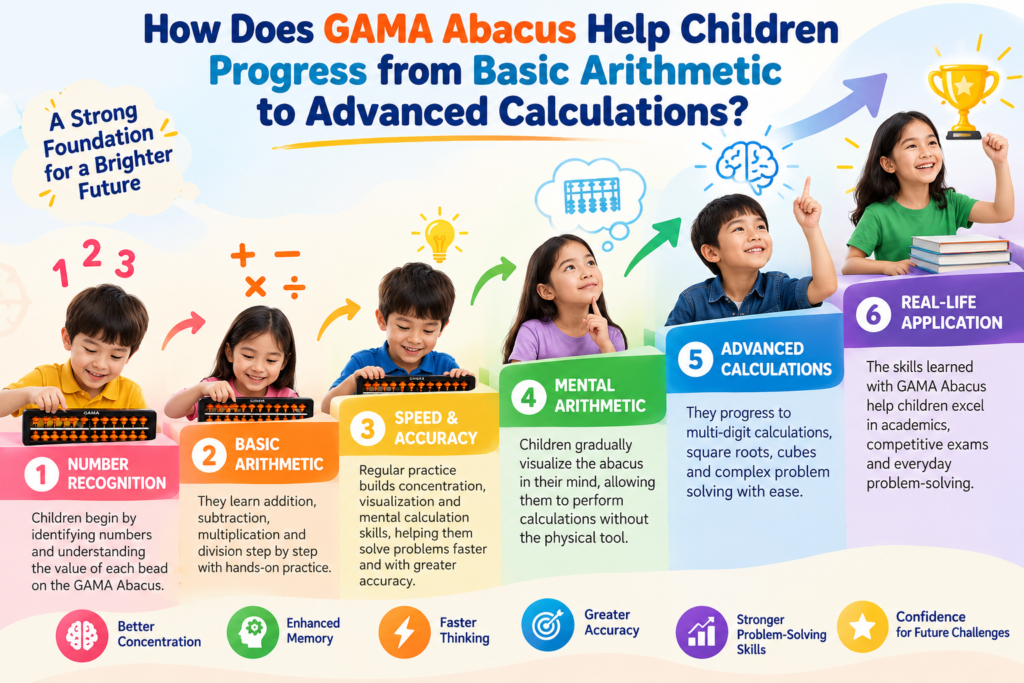
GAMA Abacus introduces children to calculation techniques through a structured programme that gradually moves from foundational number concepts to more challenging mathematical operations. Instead of expecting children to master everything at once, the learning process allows them to build familiarity with numbers and develop their calculation skills step by step. Understanding how this progression works can help parents set realistic expectations and support their child’s learning journey.
Why Is a Strong Foundation in Arithmetic Important?
Before children can solve complicated calculations, they need to understand the basics. Addition, subtraction, number values, and the relationship between numbers form the foundation for more advanced arithmetic.
Imagine a child who is still unsure about adding two small numbers. Introducing multiplication or multi-step calculations too quickly may create confusion. However, when the child understands the basic concepts, new methods become easier to follow.
The journey from Basic Arithmetic to Advanced Calculations begins with these small but important steps. Children learn to recognise numbers, understand how quantities change, and follow a calculation method in the correct order.
A strong foundation also gives children opportunities to learn from mistakes. Instead of memorising answers without understanding them, they can gradually recognise how numbers work together. This understanding becomes useful as the calculations become more challenging.
How Does GAMA Abacus Introduce Children to Basic Arithmetic?
1. Understanding Numbers Through the Abacus
For a beginner, an abacus provides a physical way to represent numbers. Children move beads along the rods to show different values and learn how those movements change a number. This step-by-step approach helps children build the foundation they need to progress from basic arithmetic to advanced calculations with greater understanding.
This makes the early stages more practical. Instead of looking at numbers only on paper, children can see and perform the movements involved in a calculation.
At GAMA Abacus, the learning approach uses the abacus as a tool for practising arithmetic and developing mental calculation skills. Children gradually become familiar with the relationship between bead movements and number values.
2. Learning Addition and Subtraction
Once children understand the basic movements, they begin practising addition and subtraction. They learn how to combine numbers, take away quantities, and follow the appropriate steps to reach an answer.
At first, children may need to concentrate on every movement. That is completely normal. With practice, familiar calculations can become easier to perform.
This stage is an important part of moving from Basic Arithmetic to Advanced Calculations because it helps children develop a dependable understanding of number operations before attempting more complex work.
Accuracy should come before speed. When children understand why a particular movement is needed, they are better prepared to apply the method to new questions.
How Do Children Progress to More Challenging Calculations?
After developing the fundamentals, children can gradually work with larger numbers and calculations involving more steps. The aim is to build on what they already understand rather than introduce every new concept at once.
Moving from basic arithmetic to advanced calculations becomes easier when children understand each concept before moving on to the next stage.
3. Building Skills Through Multiplication and Division
Multiplication and division require children to understand number relationships and follow a sequence of steps. Through guided practice, learners can become familiar with the methods used to solve these problems on an abacus.
For example, multiplication involves understanding how quantities are combined repeatedly, while division involves sharing or grouping quantities. Practising these operations can help children become more comfortable working with numbers.
The progression from Basic Arithmetic to Advanced Calculations depends on a child’s understanding of earlier lessons. Children who need additional revision should have the opportunity to practise before moving forward.
GAMA Abacus describes a curriculum that covers addition, subtraction, multiplication, and division, with further work involving whole numbers, decimals, and negative numbers. Parents can explore the GAMA Abacus training programme to learn more about the course.
These skills help children take another step towards basic arithmetic to advanced calculations through guided practice.
4. Developing the Ability to Handle Larger Numbers
As children become familiar with calculation methods, they can practise problems involving larger numbers and multiple steps. This gives them opportunities to apply the techniques they have learned in different situations.
A question that once seemed difficult may become more manageable when the child understands how to break it into smaller steps. Teachers can help learners recognise which method to use and where they need additional practice.
Progress does not mean that every child will master each calculation at the same speed. Some children may need more revision, while others may be ready for the next challenge sooner.
The important thing is that each new stage builds on a foundation the child understands.
What Is the Role of Mental Calculation?
One of the distinctive aspects of abacus training is the transition from using a physical tool to imagining the abacus mentally.
From Moving Beads to Visualising Them
Initially, children depend on the actual abacus to perform calculations. As they gain experience, they practise imagining the beads and their movements in their minds.
This process is known as mental visualisation. Instead of physically moving each bead, children picture the relevant positions and use the learned method to work towards an answer.
GAMA Abacus includes mental arithmetic and visualisation in its approach to learning. Its mental arithmetic programme explains how learners progress from using the abacus to imagining the tool while calculating.
This transition takes time and regular practice. Parents should not expect children to begin mental calculation immediately after learning the basics. The physical method provides an important foundation for developing this ability.
This gradual process connects basic arithmetic to advanced calculations by helping children apply familiar methods in a new way.
The journey from Basic Arithmetic to Advanced Calculations can therefore involve more than learning new operations. It can also involve changing how children approach and process a calculation.
How Does a Structured Curriculum SupportProgress?
A clear learning structure helps children understand what they are learning and what comes next. It also gives parents a better idea of how a programme is organised.
According to the GAMA Abacus course structure, its abacus programme is organised into eight levels over a stated duration of 28 months. The first four levels are listed as three months each, while the remaining four are listed as four months each.
A planned curriculum can make the transition from basic arithmetic to advanced calculations more organised by introducing skills progressively.
This structure provides a planned sequence for learning. However, completing a level should not be treated as the only sign of progress. Children also need to understand the concepts, practise consistently, and develop accuracy in their calculations.
A structured programme can help learners revisit earlier skills while gradually working towards more challenging exercises. This is especially useful when a new topic depends on concepts introduced in previous lessons.
For parents exploring the best abacus classes in India, it is worth checking the curriculum, teaching approach, practice expectations, and how the programme reviews each child’s progress.
Why Is Regular Practice So Important?
Attending a class introduces children to new concepts, but practice helps them become familiar with those concepts over time. Without revision, a child may forget a movement or struggle to apply a method independently.
Parents can support learning by making practice a regular part of the week. A short session that follows the teacher’s guidance may be easier to maintain than an occasional, lengthy session.
A simple routine can include:
- Revising the previous lesson.
- Practising calculations the child already understands.
- Repeating questions that caused difficulty.
- Checking answers and discussing mistakes calmly.
- Celebrating improvements in accuracy and understanding.
During the progression from Basic Arithmetic to Advanced Calculations, revision helps children connect earlier lessons with new topics. It also gives parents an opportunity to notice where extra support may be needed.
The goal is not to make every practice session perfect. It is to help children keep learning without making maths feel like a daily struggle.
How Can Parents Recognise Their Child’s Progress?
Parents sometimes expect progress to appear as faster answers. However, speed is only one aspect of learning, and it may not improve at the same rate as understanding.
Look for smaller signs of development. Your child may remember a method from the previous lesson, make fewer mistakes in familiar sums, or need less help to complete an exercise.
They may also become more willing to attempt a difficult question rather than immediately saying they cannot solve it. These changes can be meaningful signs that confidence is growing alongside calculation skills.
Parents can ask the teacher which concepts their child has mastered and which areas need more revision. This makes it easier to support learning at home without placing unnecessary pressure on the child.
Every learner follows a different path. Comparing children with classmates may create frustration, while noticing individual improvement helps keep the focus on learning.
Can Abacus Learning Support School Mathematics?
Abacus training focuses on calculation techniques, but the skills children practise may also be useful when working with school mathematics. Familiarity with numbers, repeated calculation practice, and understanding step-by-step methods can support their approach to arithmetic exercises.
However, abacus classes are not a replacement for the full school mathematics curriculum. Children still need to learn other topics, understand mathematical concepts, solve word problems, and follow the methods required by their school.
For families considering abacus classes for kids, it is helpful to view the programme as an additional learning activity rather than a substitute for schoolwork.
A balanced routine allows children to attend lessons, practise what they have learned, complete school assignments, and enjoy time for play and rest.
Abacus learning can form one part of a wider educational experience that supports familiarity with numbers and regular calculation practice. Its value depends on the child’s participation, the quality of instruction, and realistic expectations.
How GAMA Abacus Helps Children Move Forward Step by Step
Every stage of learning should give children the opportunity to understand, practise, and apply a skill before moving to the next challenge. GAMA Abacus offers a structured approach that takes learners through different calculation methods and includes mental arithmetic as part of the learning journey.
GAMA Abacus aims to guide children through the stages of basic arithmetic to advanced calculations with structured lessons and opportunities for regular practice.
Parents can enquire about the appropriate level for their child, the expected practice routine, the available online or offline class options, and how teachers assess progress.
This helps families understand how the programme fits their child’s current abilities and learning needs.
The progression from Basic Arithmetic to Advanced Calculations should not be viewed as a race. It is a gradual process in which children develop familiarity with number operations, practise increasingly challenging exercises, and work towards calculating more independently.
With regular guidance and a supportive environment, children can approach each new stage with a clearer understanding of what they have learned and what they need to practise next.
What Makes the Learning Journey Meaningful?
Children often feel proud when they solve a problem that once seemed difficult. These moments can encourage them to keep practising and approach future challenges with a more positive attitude.
The transition from Basic Arithmetic to Advanced Calculations becomes more meaningful when children understand the process instead of simply memorising answers. Teachers can support this by explaining methods clearly, allowing time for revision, and encouraging children to try different problems.
Parents also play an important role. Showing interest in what a child has learned, appreciating effort, and avoiding comparisons can help make the experience enjoyable. When children feel supported, they may become more willing to ask questions and work through challenging exercises.
For families considering mental math classes, it is worth looking beyond promises of speed. A good programme should explain how skills are introduced, how learners practise, and how progress is monitored.
Conclusion
Helping children move from simple sums to more challenging calculations takes patience, structured teaching, and regular practice. The journey from Basic Arithmetic to Advanced Calculations begins with understanding numbers, learning addition and subtraction, and gradually developing the skills needed for multiplication, division, and mental arithmetic.
GAMA Abacus follows a structured, eight-level programme that introduces calculation techniques progressively. Parents can explore the programme, ask about their child’s starting level, and understand the practice needed at each stage. Every child develops at a different pace, so progress should be measured through understanding, accuracy, and growing independence rather than speed alone.
When children receive consistent guidance and encouragement, they have more opportunities to build confidence with numbers. This approach can contribute to brain development for children through regular mental practice, while helping them approach mathematical challenges with greater confidence. The goal is not simply to reach advanced calculations quickly, but to help children build skills they can continue developing over time.