
What Is the Relationship Between Abacus and Mental Maths?
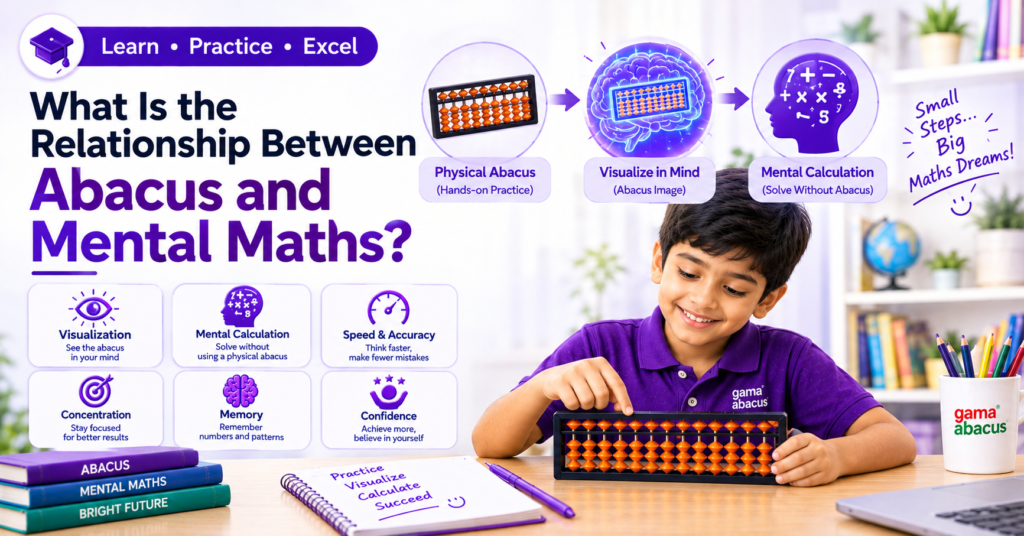
Mental calculation is an important part of a child’s mathematical development. Many parents notice that their children can solve problems when they have paper in front of them but become hesitant when asked to calculate mentally. This is where the What Is the Relationship Between Abacus and Mental Maths? becomes interesting. Abacus learning gives children a visual and practical way to work with numbers before gradually encouraging them to perform calculations without physical support.
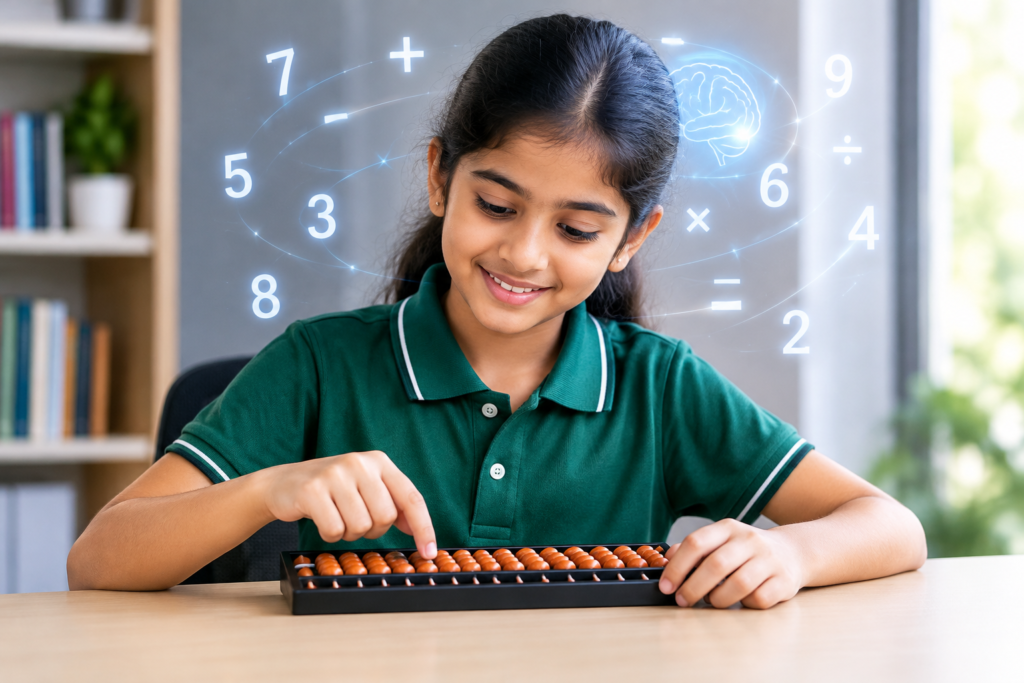
The Relationship Between Abacus and Mental Maths is not about treating abacus as a shortcut for every mathematical problem. Instead, it is about understanding how children can progress from seeing numbers, to working with them physically, to visualising them, and finally to calculating mentally. This gradual process can make number practice more structured and engaging.
Understanding the Relationship Between Abacus and Mental Maths
An abacus is a learning tool that represents numbers through the position of beads. Children can move these beads to explore quantities and perform calculations.
Mental maths, on the other hand, involves solving calculations in the mind without writing down every step. It requires children to remember numbers, understand their relationships, recognise patterns, and choose suitable ways to calculate.
The Relationship Between Abacus and Mental Maths becomes clearer when we consider how these two approaches can work together. The physical abacus gives children something concrete to see and manipulate. As children become familiar with number positions and movements, they gradually learn to visualize these movements mentally.
This creates a progression from concrete experience to abstract thinking.
Why Do Children Find Mental Calculation Difficult?
Mental calculation can be challenging when children have not yet developed a strong understanding of numbers. They may know how to follow a written method but struggle when the same calculation is presented without paper.
For example, a child may comfortably solve a written addition problem because each step is visible. When asked to solve it mentally, the child has to remember the numbers, keep track of intermediate results, and complete the operation without visual support.
This does not necessarily mean that the child is weak in mathematics. It may simply mean that the child needs more opportunities to work with numbers in different ways.
A structured approach can help children gradually become comfortable with mental calculation instead of expecting them to master it immediately.
How Does an Abacus Represent Numbers?
Before understanding mental calculation, children need to understand what numbers represent.
An abacus provides a visual representation of quantities. Different bead positions correspond to different numerical values, allowing children to see how numbers are formed.
For a young learner, this can make an abstract idea more concrete. Instead of simply looking at a written number, the child can physically represent it and observe what happens when the quantity changes.
For example, when beads are added, the child can see the number increase. When beads are moved back, the quantity decreases.
This hands-on experience can provide a useful foundation for later mental work.
From Physical Beads to Mental Images
One of the most important aspects of the Relationship Between Abacus and Mental Maths is the gradual transition from physical manipulation to visualisation.
At the beginning, children use their fingers to move the beads. They learn the positions associated with numbers and practise basic operations.
With repeated exposure, those positions become increasingly familiar. Teachers can then introduce activities that encourage children to imagine the abacus rather than physically use it.
At first, the mental image may not be clear. Children may need to look at the physical abacus occasionally or work with smaller calculations.
Over time, they can become more comfortable imagining the bead positions and mentally following the changes.
This is an important step toward developing independent mental calculation skills.
How Visualisation Supports Number Thinking
Visualisation can give children another way to think about numbers.
Instead of treating a calculation as a sequence of written symbols, a child can mentally represent the quantity and imagine how it changes.
The Relationship Between Abacus and Mental Maths therefore includes more than simply learning to move beads faster. It involves developing an internal representation that can support mental work.
For example, when solving a calculation, a child who has practised visualisation may picture the relevant bead positions and mentally adjust them.
The exact experience can differ between children. Some may form a strong visual image, while others may rely more on remembered positions or movements. What matters is that the child gradually develops a method that helps them work with numbers mentally.
What Skills Can Children Develop Through Abacus Practice?
Abacus practice can involve several mathematical and learning skills.
Number Recognition
Children repeatedly identify numbers and their corresponding bead arrangements.
Place-Value Understanding
The structure of the abacus can help children see how units, tens, hundreds, and larger values are organised.
Calculation Practice
Children can practise addition, subtraction, and other operations as they progress through their learning.
Visualisation
Mental representation becomes increasingly important as children move beyond physical bead manipulation.
Accuracy
Repeated practice gives children opportunities to become more careful with numerical operations.
Sequential Thinking
Longer calculations require children to remember and process information in the correct order.
These skills can complement a child’s wider mathematics education.
Does Abacus Automatically Make a Child Good at Mental Maths?
No. This is an important distinction for parents.
The Relationship Between Abacus and Mental Maths should not be understood as a guarantee that every child who learns abacus will automatically become an exceptional mental calculator.
Children develop at different rates. Their progress can depend on age, previous mathematical experience, consistency of practice, teaching quality, motivation, and individual learning needs.
Abacus can provide a structured environment for practising calculations and visualisation, but children still need regular learning opportunities and appropriate guidance.
It is also important to remember that mental maths involves more than speed. Understanding numbers, choosing strategies, checking answers, and applying mathematics in practical situations are all valuable.
Abacus and Mental Maths: What Is the Difference?Although theyare closely connected, abacus and mental maths are not identical.
An abacus is a tool and learning method that provides a physical representation of numbers. Mental maths is a broader ability to perform calculations and reason with numbers mentally.
The Relationship Between Abacus and Mental Maths can therefore be viewed as complementary.
A child may begin with the physical abacus, develop familiarity with numerical relationships, and gradually move towards mental calculation. However, mental maths can also be learned through other methods, such as number games, school mathematics, estimation activities, and everyday calculations.
This distinction is useful because parents should not expect abacus to replace all other forms of mathematical learning.
How Does the Transition to Mental Calculation Happen?
The transition usually develops gradually rather than happening in a single lesson.
Step 1: Physical Learning
The child first learns how to represent numbers and perform simple calculations using the abacus.
Step 2: Repeated Practice
Regular exercises help the child become familiar with number positions and common movements.
Step 3: Visual Recall
The child begins remembering what the abacus looks like for different numbers.
Step 4: Mental Visualisation
The teacher encourages the child to imagine the abacus and mentally move the beads.
Step 5: Independent Mental Calculation
With practice, the child can increasingly perform calculations without physically touching the instrument.
This progression explains an important part of the Relationship Between Abacus and Mental Maths. The physical tool provides an initial reference, while mental visualisation gradually becomes more important.
Why Is Consistent Practice Important?
Learning mental calculation is not something that happens simply by attending classes. Children need opportunities to revisit what they have learned.
Short, regular practice sessions can be easier for children to maintain than occasional long sessions. The exact amount of practice depends on the child’s age, level, and programme.
Parents should avoid turning practice into a stressful activity. If a child is tired or frustrated, forcing additional exercises may not produce better learning.
Instead, consistency and encouragement can help establish a positive routine.
For families considering the best abacus classes in India, it is worth looking at the programme’s teaching structure, progression, practice support, and approach to individual learners rather than focusing only on advertised calculation speed.
How Can Parents Support Mental Calculation at Home?
Parents can encourage number thinking through simple everyday activities.
For example, while shopping, ask children to estimate the total cost of two items. While cooking, involve them in counting or measuring. During travel, ask how many minutes remain before reaching a destination.
These activities do not need to become formal lessons. The purpose is simply to give children opportunities to think about numbers outside the classroom.
Parents whose children attend abacus classes for kids can also encourage them to explain how they arrived at an answer. Asking “How did you work that out?” can be more useful than immediately telling them whether the answer is right or wrong.
Can Abacus Support School Mathematics?
Abacus should be considered a supporting learning method rather than a replacement for school mathematics.
Children need to develop many mathematical skills, including geometry, measurement, patterns, reasoning, word problems, estimation, and mathematical communication.
The Relationship Between Abacus and Mental Maths is particularly relevant to numerical calculation, but children still need opportunities to explore mathematics in broader contexts.
When abacus practice is combined with school learning and everyday mathematical experiences, children can encounter numbers in different ways.
What Should Parents Look for in an Abacus Programme?
Parents should consider more than the number of levels or the promise of fast calculations.
A suitable programme should provide:
- Age-appropriate instruction
- A clear progression from basic to advanced concepts
- Regular opportunities for practice
- Teachers who can explain concepts clearly
- Gradual introduction of mental calculation
- Appropriate feedback on children’s progress
- A learning environment that encourages questions
Parents may also compare different mental math classes to understand which teaching approach best suits their child.
The right choice depends on the child’s age, learning needs, schedule, and comfort with the teaching method.
Making Mental Maths More Meaningful
Mental calculation becomes more useful when children understand why they are learning it.
Instead of presenting every exercise as a race, parents and teachers can encourage children to think about how numbers relate to one another.
For example, children can learn to recognise that some numbers can be broken into easier combinations. They can estimate an answer before calculating it and check whether the final result makes sense.
These habits encourage flexible mathematical thinking.
The Relationship Between Abacus and Mental Maths is therefore not limited to performing calculations quickly. It can also involve helping children become more familiar with numbers and more comfortable thinking about them.
Abacus as Part of a Broader Learning Journey
Abacus learning can provide children with regular opportunities to work with numbers, practise calculations, and develop visual representations.
However, no single learning activity develops every mathematical ability. Children benefit from a balanced educational experience that includes school mathematics, practical activities, reasoning, reading, games, and exploration.
Similarly, claims about brain development for children should be viewed carefully. Abacus practice can involve attention, visualisation, memory, and numerical processing, but individual outcomes vary and should not be exaggerated.
A realistic approach is to see abacus as one useful component of a child’s wider learning journey.
Conclusion
The Relationship Between Abacus and Mental Maths can be understood as a gradual progression from physical number representation to mental calculation. Children can begin by moving beads, develop familiarity with numerical positions, practise calculations, and eventually learn to visualise the abacus while working mentally.
Abacus is not a replacement for mathematics education, and mental maths is broader than abacus-based calculation. However, structured abacus practice can give children a concrete starting point for exploring numbers and gradually developing greater comfort with mental calculations.
For parents, the focus should be on understanding, consistency, suitable instruction, and steady progress rather than speed alone. When children are given enough time to build each skill, the Relationship Between Abacus and Mental Maths can become a meaningful part of their overall mathematical learning.