
How Do Children Transition From a Physical Abacus to Mental Calculation?
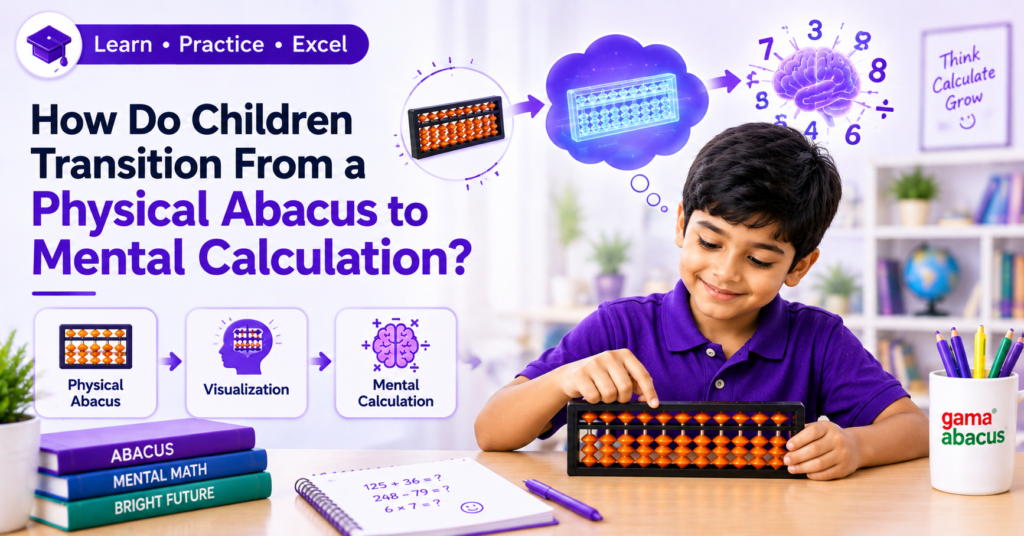
Learning mathematics often begins with something children can see and touch. For many learners, the abacus provides that bridge. But how does a child move from moving beads with their fingers to calculating numbers mentally? The Physical Abacus to Mental Calculation journey is a gradual learning process in which children first understand quantities, practise movements, build visual memory, and eventually learn to imagine the abacus in their mind.
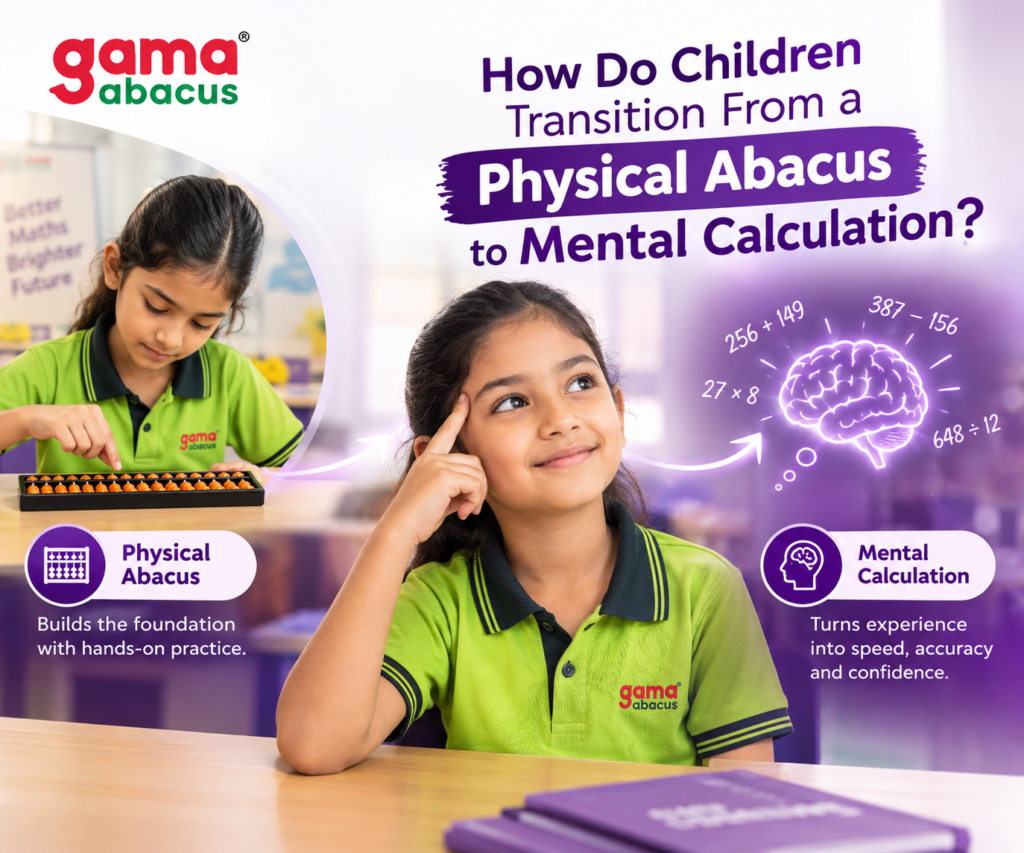
Understanding the Physical Abacus to Mental Calculation journey can help parents set realistic expectations. Children do not usually stop using the physical tool suddenly. Instead, they gradually become more comfortable working with numbers, patterns, and imagined bead movements. With structured teaching and regular practice, the physical abacus can become a foundation for mental calculation.
What Is the Physical Abacus to Mental Calculation Journey?
The Physical Abacus to Mental Calculation process can be understood as a progression rather than a single step. A child may begin by physically moving beads to represent numbers. As lessons continue, the child learns what different bead positions mean and how numbers change when beads are added or removed.
Later, the teacher may ask the child to look at an abacus, listen to a calculation, and solve it without physically moving the beads. With continued practice, the child begins to create a mental picture of the abacus. Eventually, the physical tool becomes less necessary for familiar calculations.
Every child progresses differently based on their age, learning speed, practice routine, and teaching approach.Some children move forward quickly, while others need more time with each stage.
Stage 1: Understanding Numbers Through Beads
The first stage of the Physical Abacus to Mental Calculation journey is concrete learning. Children can see the beads and physically move them. This gives an abstract number a visible form.
For example, instead of simply being told that a number is five, a child can represent five on the abacus and observe its position. This makes the learning experience more interactive and gives children a practical way to explore numbers.
Children should first develop accuracy before gradually working toward faster calculations. Children need to become familiar with finger movements, bead values, place value, and basic operations. A strong foundation helps make later mental work easier.
Stage 2: Building Finger and Visual Coordination
Once children understand how the abacus represents numbers, they begin practising movements repeatedly. The goal is not simply to move beads quickly. Children are learning to connect what they see with what their fingers do.
This stage is an important part of Physical Abacus to Mental Calculation because children begin connecting physical movement with mental understanding. Repeated practice can strengthen the association between a number and its position on the abacus.
When a child hears a number, they gradually become better at identifying where it would appear. When they perform an operation, they begin remembering the movement required to change the number.
This is one reason structured practice matters. Short, regular sessions can give children opportunities to repeat familiar patterns without making every lesson feel overwhelming.
Stage 3: Reducing Dependence on the Physical Tool
The next stage is where the Physical Abacus to Mental Calculation transition becomes more noticeable. Teachers may introduce exercises in which children first observe the abacus and then solve a calculation without touching the beads.
At first, this can feel difficult. A child who is comfortable with a physical abacus may suddenly need to remember bead positions without seeing them. That is normal.
The aim is to develop an internal representation of the abacus. Children begin to remember the position of beads and the movements associated with calculations. They are not simply memorising answers; they are learning a visual and procedural way to work with numbers.
Gradually, children may need fewer physical demonstrations as they become familiar with the patterns involved.
Stage 4: Creating a Mental Image of the Abacus
The Physical Abacus to Mental Calculation transition becomes clearer when children start imagining the abacus instead of looking at it. This is a key part of developing mental calculation skills.
A teacher might present a calculation and ask the child to visualise the relevant beads. The child mentally moves the beads while keeping track of the changing value.
At this point, the learner is moving toward mental calculation. The physical instrument has served its purpose as a concrete learning aid, while the child’s mental representation becomes increasingly important.
Children may initially need prompts, slower calculations, or visual reminders. Over time, those supports can be reduced as confidence and familiarity increase.
Stage 5: Performing Mental Calculations
The final stage of the Physical Abacus to Mental Calculation process involves using the mental image to solve calculations. Instead of physically manipulating beads, the child works with the imagined representation.
For example, when a child hears a sequence of numbers, they may mentally picture the abacus and carry out the corresponding movements. With practice, the process can become more familiar and automatic.
The speed at which this happens varies from child to child. Parents should focus on steady progress rather than comparing one child’s timeline with another’s. Accuracy, understanding, and confidence provide a more useful foundation than rushing to achieve speed.
Why Is the Physical Abacus Important?
It may seem that the physical tool becomes unnecessary once mental calculation begins. However, understanding Physical Abacus to Mental Calculation starts with recognising why the physical tool matters.
The abacus gives children something concrete to work with. They can observe how quantities change, connect numbers with positions, and physically experience the steps involved in a calculation.
For younger learners especially, moving directly to abstract mental work may be challenging. The physical stage gives them a reference point. As their understanding develops, that reference can gradually shift from the desk to the mind.
This is similar to many learning processes in which children first use concrete objects before moving toward more abstract thinking.
How Teachers Support the Transition
A good learning sequence does not expect children to jump from physical practice to advanced mental work immediately. Teachers can introduce intermediate activities that gradually reduce the child’s dependence on the instrument.
In a structured Physical Abacus to Mental Calculation programme, teachers may use activities such as:
- Looking at an abacus and identifying numbers quickly
- Listening to numbers and visualising bead positions
- Performing simple additions and subtractions mentally
- Increasing the number of steps in a calculation gradually
- Using timed practice only after the child understands the process
- Revisiting earlier concepts when a child needs reinforcement
The teaching pace should match the learner. A child who needs additional practice should not be made to feel that taking more time is a failure.
How Much Practice Do Children Need?
There is no single practice schedule that works for every child. The ideal routine depends on age, level, attention span, previous experience, and the complexity of the exercises.
Short and consistent practice is often easier for children to maintain than occasional long sessions. Parents can create a simple routine at home by setting aside a regular time for practice and keeping the environment calm.
The goal should be quality practice. If a child is tired or frustrated, extending the session may not produce better learning. Encouragement and consistency can help children build a positive routine.
For families comparing programmes, it can be useful to look at how teachers explain progression, provide practice materials, monitor understanding, and support children who learn at different speeds. Parents researching the best abacus classes in India may also want to examine course structure and teaching approach rather than choosing based only on advertised speed.
What Role Does Visualisation Play?
Visualisation is central to mental calculation because the child needs an internal way to represent numbers and operations.
A physical abacus provides an external image. Through repeated experience, the child becomes familiar with the position and movement of beads. Later, that external image can be mentally reproduced.
In the Physical Abacus to Mental Calculation process, this mental representation can become an important bridge between physical practice and independent calculation.
This does not mean every child will visualise in exactly the same way. Some may form a clear mental picture, while others may rely more on a sense of movement, position, or number pattern.
The important point is that children develop a mental representation that helps them work through calculations without physically manipulating the beads.
Can Every Child Make the Transition?
Children learn at different rates, so the transition should not be treated as a fixed timetable. Some children may become comfortable with mental work relatively quickly, while others may benefit from longer periods of physical practice.
Previous mathematical experience, attention, motivation, practice consistency, and teaching support can all influence progress.
The purpose of Physical Abacus to Mental Calculation is not to pressure children into mental calculation before they are ready. A well-paced programme can allow children to build one skill on top of another.
Parents can support this by celebrating improvement rather than focusing only on speed. Questions such as “Can you explain how you got theanswer?”can encourage understanding and reflection.
How Parents Can Support the Learning Process
Parents do not need to teach every abacus technique at home. Their main role can be creating a supportive environment.
A few simple habits can help:
- Encourage regular practice without turning it into a punishment.
- Celebrate accurate work and gradual improvement.
- Avoid comparing the child with siblings or classmates.
- Give the child enough time to think before providing an answer.
- Ask what strategy the child used.
- Keep practice sessions manageable.
- Communicate with the teacher if the child is repeatedly struggling with a concept.
Children who attend abacus classes for kids can also benefit when parents understand that progress may happen in stages. A child may appear slower during a new mental exercise and then become more comfortable after repeated exposure.
From Beads to Mental Calculation: A Gradual Learning Process
The Physical Abacus to Mental Calculation journey is not about abandoning the tool as quickly as possible. It is about using the tool as a foundation and gradually developing an internal understanding of numbers.
A child first sees the beads, then learns to move them, then remembers their positions, and eventually begins to work with an imagined abacus. Each stage builds on the previous one.
For this reason, parents should look for programmes that value understanding, structured progression, regular practice, and age-appropriate instruction. The physical tool is only one part of the process. The larger goal is to help children become comfortable working with numbers in their own minds.
The Role of Abacus in Broader Learning
Abacus training can be one way of giving children structured opportunities to practise number operations and mental calculation. It should not be viewed as a replacement for all forms of mathematics education. School mathematics, problem-solving activities, reading, reasoning, and everyday experiences with numbers all have their own roles.
When children practise consistently and understand what they are doing, abacus learning can become part of a broader mathematical foundation. Parents looking for mental math classes should consider whether the programme provides clear instruction, regular feedback, and opportunities for children to apply what they learn.
Conclusion
The journey from a physical abacus to mental calculation happens gradually. Children begin by seeing and moving beads, then develop familiarity with positions and movements, build mental images, and eventually use those images to work through calculations.
The Physical Abacus to Mental Calculation process is most effective when children are given time to understand each stage instead of being pushed to perform quickly. With patient instruction, regular practice, and encouragement at home, children can gradually become more comfortable performing calculations mentally.
For parents, the key is to focus on the learning journey rather than expecting instant results. A structured programme can provide the practice and guidance children need while allowing each learner to progress at a suitable pace.
Abacus training can also be considered alongside other educational experiences that support brain development for children. What matters most is creating a balanced learning environment in which children can build mathematical understanding, confidence, and independent thinking.