
What Do Children Actually Learn in Abacus Classes?
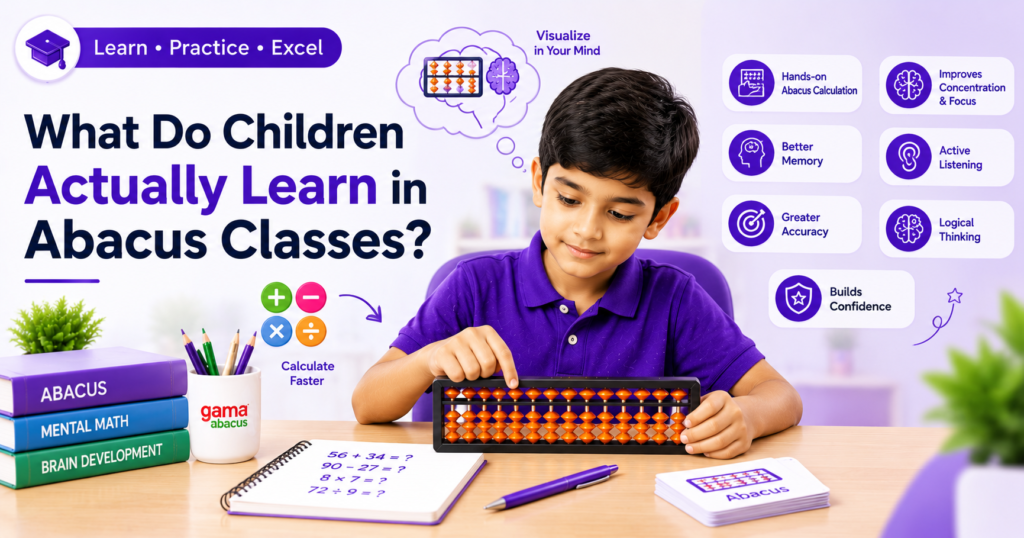
Parents often wonder, what do children actually learn in abacus classes beyond simply moving beads and solving numbers? Abacus education is not only about performing calculations quickly. With regular practice, children learn how numbers work, how to break down calculations into smaller steps, and how to approach mathematical problems with greater confidence. The learning process combines hands-on activities, mental calculation, concentration, listening, memory, and repeated practice.
For many children, mathematics can initially feel like a subject where they have to remember too many rules. An abacus provides a visual and physical way to understand numbers. As children progress, they gradually move from using the physical tool to imagining the abacus mentally while performing calculations.
So, what do children actually learn in abacus classes? Let us look at the skills and learning habits children can develop through structured abacus training.
What Do Children Actually Learn in Abacus Classes?
The first thing children learn is a practical understanding of numbers. Instead of seeing numbers only as symbols written on a page, they use beads to represent quantities and perform calculations step by step.
During beginner-level lessons, children usually learn how to represent numbers, understand place value, and perform basic operations. As their skills develop, exercises become more challenging and require greater speed, accuracy, attention, and mental visualization.
This makes abacus learning different from simply memorizing calculation shortcuts. Children repeatedly practise the same concepts until the process becomes more familiar.
1. Number Sense and Place Value
One of the foundations of abacus education is understanding how numbers are structured.
Children learn to recognize ones, tens, hundreds, and larger place values through the position of beads. For example, instead of simply memorizing that 25 is made up of 2 tens and 5 ones, they can physically see and manipulate those quantities.
This hands-on experience can make abstract numerical concepts easier for young learners to understand.
Over time, what do children actually learn in abacus classes becomes clearer: they are learning how numbers relate to one another, rather than simply learning how to write answers.
2. Addition and Subtraction
Addition and subtraction are among the first mathematical operations children practise on an abacus.
A child may begin with simple calculations and gradually move towards larger numbers. The abacus allows them to see how quantities increase or decrease as beads are moved.
Repeated practice helps children become more comfortable with calculation procedures. Rather than rushing to get an answer, they learn to follow a sequence of movements and understand what each step represents.
This can also encourage children to check their work and become more aware of calculation accuracy.
How Abacus Practice Develops Mental Calculation
As children become comfortable with physical abacus calculations, many programmes introduce mental calculation exercises. This is where the learning process becomes particularly interesting.
Instead of physically moving beads, children are encouraged to visualise the abacus in their mind and imagine the required movements.
3. Mental Calculation
Mental calculation involves solving numerical problems without writing down every intermediate step.
In abacus training, children gradually practise creating a mental image of the abacus. They then use that mental representation while calculating.
This skill does not appear instantly. It generally develops through repeated exposure to physical abacus exercises followed by increasingly challenging mental practice.
The goal is not simply to make children calculate faster. It is to help them become more comfortable holding numerical information in their mind.
This is one reason parents asking what do children actually learn in abacus classes should look beyond calculation speed. The learning process also involves mental representation and structured thinking.
4. Concentration and Attention
Children need to pay attention to instructions, numbers, bead positions, and calculation sequences during an abacus lesson.
For example, a child may need to listen to a series of numbers and perform calculations without losing track of the sequence. Regular exercises like these require sustained attention.
This can make concentration an important part of the learning experience.
Of course, an abacus class should not be viewed as a guaranteed solution for every attention-related difficulty. Children differ considerably in their learning styles and development. However, activities that require focused participation can provide useful opportunities to practise attention.
What Do Children Actually Learn in Abacus Classes Besides Maths?
Abacus lessons can involve several skills that support the learning process beyond basic arithmetic.
5. Listening and Following Instructions
Many abacus activities require children to listen carefully before responding.
A teacher may provide a sequence of numbers or instructions that the child needs to remember and apply correctly. If the child misses one step, the final answer may be affected.
Through regular practice, children learn the importance of listening carefully and completing instructions in the correct order.
This is particularly useful in classroom environments where children regularly need to process spoken instructions.
6. Memory and Mental Visualization
Memory plays a role when children remember number sequences, calculation patterns, and imagined bead positions.
As children progress towards mental calculation, they may picture the abacus without physically holding it. This requires them to maintain a mental representation while manipulating numbers.
The ability to visualize information can be useful in many learning situations, although its development varies from child to child.
When parents ask what do children actually learn in abacus classes, mental visualization is therefore an important part of the answer.
Building Accuracy Through Repeated Practice
Speed often receives the most attention when people talk about abacus training, but accuracy is equally important.
7. Accuracy and Checking
Children learn that getting an answer quickly is not enough if the answer is incorrect.
Abacus exercises often involve repeated calculations where children need to maintain both speed and accuracy. With practice, they become familiar with common calculation patterns and learn to work carefully under time limits.
Teachers can also encourage children to identify mistakes and understand where a calculation went wrong.
This creates an opportunity for children to see mistakes as part of the learning process rather than somethingto fear.
8. Problem-Solving Habits
Abacus training gives children structured numerical problems to solve.
Instead of guessing an answer, they learn to follow a process: understand the numbers, perform the required operations, and arrive at a result.
This approach can support mathematical thinking because children become accustomed to breaking a problem into manageable steps.
It is also important to remember that abacus education complements regular mathematics education. Children still need opportunities to understand mathematical concepts, reasoning, word problems, geometry, measurement, and other areas of mathematics.
What Do Children Actually Learn in Abacus Classes at Different Levels?
The learning experience changes as children move through different stages.
Beginner Stage
At the beginning, children typically focus on learning the abacus structure, number representation, place value, and simple calculations.
At this stage, physical movement is especially important because children are becoming familiar with the relationship between numbers and bead positions.
Intermediate Stage
Once the basics are comfortable, children can work with larger numbers and more complex calculations.
They may also begin spending more time on mental calculation. Exercises can require greater concentration and faster processing.
Advanced Stage
At higher levels, children may solve longer sequences and increasingly challenging calculations mentally.
The emphasis can shift towards combining accuracy, speed, memory, concentration, and visualization.
This gradual progression explains what do children actually learn in abacus classes over time. The answer changes as the child moves from physical manipulation to more advanced mental calculation.
Can Abacus Learning Support a Child’s Overall Learning?
Parents often look for activities that can complement school education. Abacus learning brain development for children is sometimes discussed in this context, but it is important to keep expectations realistic.
Abacus training can provide repeated practice in numerical processing, attention, memory, and visualization. These are useful learning skills, but individual results depend on factors such as the child’s age, consistency, teaching approach, motivation, and learning environment.
Abacus should therefore be viewed as one educational activity rather than a replacement for regular schooling or mathematics instruction.
How Can Parents Make Abacus Practice More Effective?
The learning process becomes more useful when children practise consistently without feeling excessive pressure.
Parents can support children by:
- Encouraging regular short practice sessions.
- Celebrating improvement rather than only perfect scores.
- Allowing children enough time to understand new concepts.
- Avoiding comparisons with other children.
- Asking children to explain how they reached an answer.
- Keeping practice positive and age-appropriate.
For younger learners especially, enjoyment matters. A child who feels confident and interested is more likely to participate consistently.
Parents considering abacus classes for kids should also look at the teaching method, class size, progression system, practice schedule, and whether the programme is appropriate for their child’s age and learning level.
Why Do Some Children Enjoy Abacus Learning?
Children often enjoy activities where they can actively participate rather than simply listen.
The abacus provides something physical to touch and manipulate. Beads move, numbers change, and answers can be checked quickly. This can make early mathematical practice feel more interactive.
As children become more familiar with the process, some may enjoy the challenge of completing calculations accurately within a given time.
However, not every child will have the same experience. Some children may enjoy mental calculation, while others may prefer visual or activity-based approaches.
The Role of Mental Maths in Abacus Education
The transition from physical bead movement to mental calculation is an important part of many abacus programmes.
Mental math classes may focus directly on calculating without physical tools, while abacus programmes often use the physical abacus as an initial learning aid before introducing mental visualization.
The two approaches can overlap, but they are not necessarily identical. Parents should understand the specific teaching method used by a programme before choosing it.
Ultimately, what do children actually learn in abacus classes depends partly on how the programme is designed and delivered.
What Parents Should Look for in an Abacus Programme
A good learning environment should focus on understanding as well as practice.
Parents can consider whether the programme:
- Introduces concepts gradually.
- Uses age-appropriate activities.
- Gives children enough practice without unnecessary pressure.
- Tracks individual progress.
- Encourages accuracy alongside speed.
- Provides clear feedback.
- Maintains communication with parents.
- Helps children understand rather than simply memorise procedures.
The best abacus classes in India will not necessarily be the same choice for every child. Families should consider teaching quality, curriculum, convenience, class format, teacher experience, and the individual needs of the learner.
Conclusion: What Do Children Actually Learn in Abacus Classes?
So, what do children actually learn in abacus classes?
They learn much more than how to move beads. Depending on the programme and the child’s progress, abacus training can introduce number sense, place value, addition, subtraction, mental calculation, concentration, listening, memory, visualization, accuracy, and structured problem-solving.
The most important point is that children develop these skills gradually. Abacus is not a magic shortcut that makes every child instantly better at mathematics. Its value comes from consistent practice, appropriate instruction, and a learning environment that encourages children to understand what they are doing.
For parents, the goal should not be to focus only on how quickly a child can calculate. A more meaningful question is whether the child is becoming more comfortable with numbers, approaching calculations with confidence, and developing positive learning habits.
That is the bigger picture behind what do children actually learn in abacus classes: a structured way to work with numbers while practising attention, memory, visualization, and mathematical thinking.