
Can Abacus Help Children Become Better Problem Solvers?
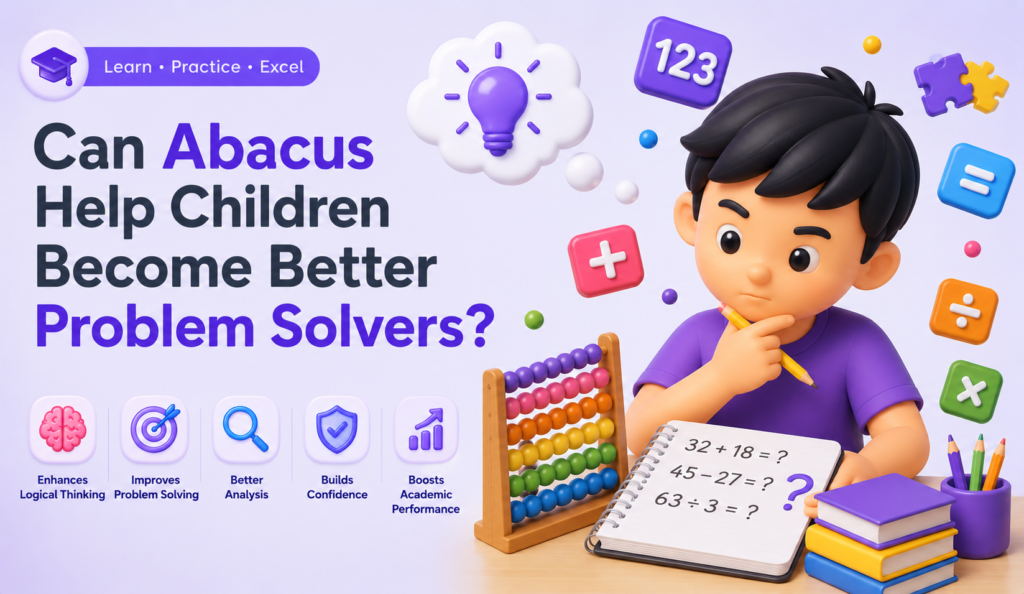
Parents today want more than just good grades for their children. They want their children to develop skills that will help them succeed in academics, future careers, and everyday life. One of the most important of these skills is problem-solving. The ability to analyse situations, think logically, and find effective solutions is valuable in almost every aspect of life. This is why many parents often ask, Can Abacus Help Children Become Better Problem Solvers?
The answer is yes. Abacus training is much more than a method for learning arithmetic calculations. It is a powerful brain development program that helps children strengthen concentration, memory, logical reasoning, and analytical thinking. These abilities play a significant role in developing strong problem-solving skills from an early age.
Children enrolled in the best abacus classes in india often gain benefits that extend far beyond mathematics. Through regular practice and mental visualization techniques, they learn how to think clearly, evaluate situations, and approach challenges with confidence.

Can Abacus Help Children Become Better Problem Solvers?Understanding the Connection
Problem-solving is the process of identifying a challenge, analysing available information, and finding an effective solution. Whether a child is solving a math question, completing a science project, or dealing with a real-life situation, problem-solving skills are essential.
When parents ask, Can Abacus Help Children Become Better Problem Solvers?, they are often looking for activities that strengthen these important thinking abilities. Abacus training provides exactly that by encouraging children to think actively rather than simply memorizing answers.
Instead of relying on calculators or shortcuts, children learn to process information mentally and work through solutions step by step. This structured thinking process naturally improves problem-solving abilities.
How Abacus Encourages Logical Thinking
Logical thinking is at the heart of effective problem-solving.
Abacus training requires children to follow specific methods while performing calculations. Every movement of the beads represents a numerical value, and children must understand how these values interact to arrive at the correct answer.
As they practice regularly, children learn to:
- Analyse information carefully
- Follow logical sequences
- Recognize patterns
- Make accurate decisions
- Evaluate different possibilities
These habits strengthen their ability to think logically and approach challenges in a systematic manner.
Can Abacus Help Children Become Better Problem Solvers? By Teaching Structured Thinking
One reason many educators support abacus learning is its emphasis on structured thinking.
Children are encouraged to solve problems by following a clear process rather than guessing answers. They learn to break complex calculations into smaller, manageable steps and solve them systematically.
This approach helps children develop confidence when facing challenges because they understand how to work through problems rather than feeling overwhelmed by them.
Over time, these thinking habits become useful not only in mathematics but also in academics and everyday life.
The Role of Concentration in Problem-Solving
Strong concentration is essential for effective problem-solving.
Children who struggle to focus often find it difficult to analyse information, identify patterns, or complete tasks accurately. Abacus training helps strengthen concentration by requiring students to focus carefully during calculations.
As children progress, they begin performing calculations mentally through visualization techniques. This process demands sustained attention and encourages children to remain focused for longer periods.
Improved concentration allows children to:
- Understand problems more clearly
- Avoid careless mistakes
- Process information efficiently
- Stay engaged until a solution is found
These benefits contribute significantly to stronger problem-solving abilities.
How Visualization Supports Better Problem-Solving
Visualization is one of the most unique aspects of abacus training.
As students advance through different levels, they learn to picture the abacus mentally and manipulate the beads in their minds. This mental imagery strengthens both memory and creative thinking.
When considering Can Abacus Help Children Become Better Problem Solvers?, visualization plays an important role because it helps children learn to imagine different possibilities and explore solutions mentally before taking action.
This skill can be valuable in many situations, including:
- Solving mathematical problems
- Understanding scientific concepts
- Planning projects
- Making decisions
- Creative thinking activities
Visualization encourages flexible thinking, which is an important part of effective problem-solving.
Can Abacus Help Children Become Better Problem Solvers? Through Improved Memory
Memory is closely connected to problem-solving.
Children need to remember information, instructions, formulas, and previous experiences when finding solutions. A stronger memory allows them to access relevant knowledge quickly and apply it effectively.
Abacus training strengthens memory by encouraging children to visualize numbers and calculations mentally. Regular practice improves both short-term and long-term memory retention.
As memory improves, children become better equipped to:
- Recall information accurately
- Apply learned concepts
- Connect ideas effectively
- Solve problems more efficiently
This is another reason why abacus education supports overall cognitive development.
Developing Analytical Thinking Skills
Analytical thinking involves examining information carefully and drawing logical conclusions.
Abacus exercises encourage children to analyse numbers, identify relationships, and determine the most efficient way to solve calculations. These activities strengthen the brain’s ability to process information systematically.
Children who develop strong analytical skills often become more effective problem solvers because they learn to:
- Assess situations objectively
- Identify important details
- Recognize patterns
- Evaluate possible solutions
- Make informed decisions
These abilities are valuable throughout a child’s educational journey and beyond.
Building Confidence Through Problem-Solving Success
Confidence is an important part of becoming a good problem solver.
Children who doubt their abilities may hesitate to attempt challenging tasks or give up quickly when faced with difficulties. On the other hand, confident children are more willing to explore solutions and learn from mistakes.
Abacus training provides regular opportunities for achievement. As children solve increasingly complex calculations and progress through different levels, they gain confidence in their abilities.
When parents ask, Can Abacus Help Children Become Better Problem Solvers?, confidence is often one of the most overlooked benefits. Children who believe in themselves are more likely to tackle challenges with determination and persistence.
Can Abacus Help Children Become Better Problem Solvers? Beyond Mathematics
Many people assume that abacus training only benefits mathematics. In reality, the skills developed through abacus learning can support many other areas of life.
Problem-solvingskills gained through abacus training can help children:
- Understand academic concepts more effectively
- Complete school assignments with greater confidence
- Participate actively in classroom discussions
- Make thoughtful decisions
- Handle everyday challenges independently
The ability to think logically and solve problems is useful in almost every situation a child encounters.
Why Problem-Solving Skills Matter in Today’s World
The modern world is constantly changing, and children need more than academic knowledge to succeed.
Future success requires skills such as:
- Critical thinking
- Adaptability
- Decision-making
- Creativity
- Problem-solving
Educational programs that strengthen these abilities can provide long-term advantages for children.
This is why many parents are increasingly interested in activities that develop cognitive skills rather than focusing solely on academic content.
Can Abacus Help Children Become Better Problem Solvers? What Parents Should Know
Parents considering abacus training should understand that the benefits extend far beyond faster calculations.
Abacus learning helps children develop important mental abilities through consistent practice and structured exercises. These abilities support concentration, memory, logical thinking, analytical reasoning, and confidence all of which contribute to stronger problem-solving skills.
The key to success is regular participation and proper guidance. Children who practice consistently often experience noticeable improvements in their thinking abilities over time.
The Long-Term Benefits of Abacus Training
One of the greatest advantages of abacus education is that its benefits continue long after the training is completed.
Children who develop strong problem-solving skills often find it easier to:
- Learn new concepts
- Adapt to challenges
- Make informed decisions
- Work independently
- Achieve academic success
These skills remain valuable throughout school, higher education, and future careers.
As a result, abacus training can be viewed as an investment in a child’s long-term development.
Conclusion
So, Can Abacus Help Children Become Better Problem Solvers? The answer is a definite yes.
Abacus training does much more than teach arithmetic calculations. It strengthens concentration, memory, visualization, logical thinking, analytical reasoning, and confidenceskills that form the foundation of effective problem-solving.
By encouraging children to think systematically and approach challenges with confidence, abacus education helps prepare them for success both inside and outside the classroom. For parents seeking an activity that supports overall brain development while nurturing valuable life skills, abacus training remains one of the most effective choices available today.
Children who participate in the best abacus classes in india often gain abilities that extend far beyond mathematics, helping them become confident learners, independent thinkers, and capable problem solvers for years to come