
How Children Learn Fast Calculations Through Abacus
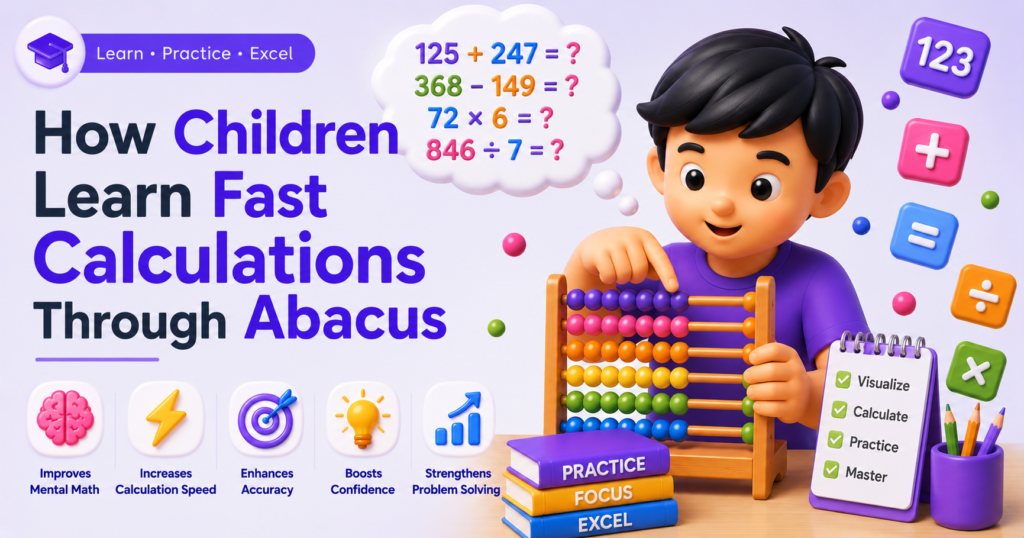
Mathematics is an essential subject that influences many areas of a child’s academic journey and everyday life. However, for many children, solving calculations quickly and accurately can be challenging. They may understand mathematical concepts but struggle with speed, confidence, or concentration during classroom activities and examinations. This is where How Children Learn Fast Calculations Through Abacus becomes an important topic for parents who want to strengthen their child’s mathematical abilities naturally.
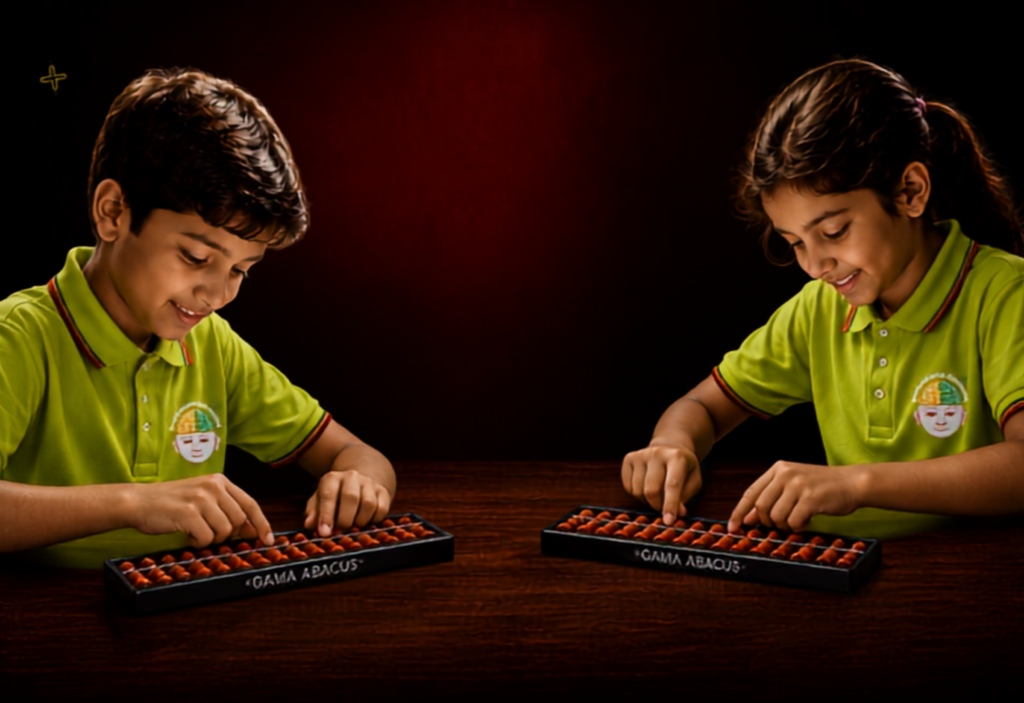
Abacus training is much more than learning arithmetic. It is a structured brain development program that improves concentration, memory, visualization, observation, and logical thinking while developing remarkable mental calculation skills. Through consistent practice, children gradually move from using a physical abacus to performing complex calculations mentally with speed and accuracy. This unique learning method builds confidence and creates a strong mathematical foundation that benefits children throughout their education. Many parents searching for the best abacus classes in india choose structured abacus programs because they focus on overall cognitive development rather than simply teaching arithmetic.
Why Fast Calculation Skills Matter
Fast calculation is not about solving problems in a hurry. It is about processing numbers accurately and confidently without unnecessary delays.
Children who develop quick calculation skills often experience several academic advantages, including:
- Better performance in mathematics
- Improved confidence during exams
- Faster problem-solving abilities
- Better time management
- Reduced calculation errors
These skills also help children in everyday situations such as managing money, measuring quantities, estimating values, and making quick numerical decisions.
Developing fast calculation skills at an early age creates a strong academic foundation that supports learning across multiple subjects.
How Children Learn Fast Calculations Through Abacus by Understanding Numbers
One of the biggest strengths of abacus learning is that children develop a genuine understanding of numbers rather than memorizing procedures.
Instead of depending entirely on written methods, children learn how numbers are formed, combined, and separated using the beads of the abacus.
This hands-on learning approach helps children understand concepts such as:
- Place value
- Addition
- Subtraction
- Multiplication
- Division
Once these concepts become clear, solving calculations becomes easier and much faster.
Rather than memorizing formulas without understanding them, children build a deep connection with numbers that improves their confidence in mathematics.
Learning with the Physical Abacus
Every child begins their journey by using a physical Japanese soroban abacus.
The colourful beads make learning enjoyable and interactive.
During the initial stages, children learn:
- Number recognition
- Bead movement
- Finger coordination
- Basic arithmetic operations
Each calculation requires children to move the beads correctly while observing their positions carefully.
This practical learning process strengthens hand-eye coordination and develops strong number sense.
Instead of viewing mathematics as a difficult subject, children begin enjoying calculations through engaging activities.
How Children Learn Fast Calculations Through Abacus Through Visualization
Visualization is one of the most unique aspects of abacus education.
After mastering the physical abacus, children gradually begin imagining the abacus inside their minds.
Instead of moving real beads, they mentally visualize every movement while solving calculations.
This process strengthens:
- Mental imagery
- Concentration
- Memory
- Information processing
Visualization allows children to solve increasingly complex calculations without depending on paper or calculators.
As their visualization skills improve, calculation speed naturally increases.
This mental ability becomes one of the greatest advantages of abacus learning.
Strengthening Memory for Faster Calculations
Memory is closely connected to calculation speed.
Children who remember number patterns quickly spend less time thinking about each step.
Abacus continuously exercises working memory because students must remember bead positions while performing calculations mentally.
Regular practice improves:
- Short-term memory
- Long-term memory
- Number recall
- Mental organization
As memory improves, children solve arithmetic problems more confidently and with fewer mistakes.
Better memory also benefits school subjects beyond mathematics.
Improves Concentration During Calculations
Fast calculation requires complete concentration.
Even a small distraction can lead to mistakes.
Abacus training develops concentration by encouraging children to remain fully engaged throughout every exercise.
During practice, students must:
- Listen carefully
- Observe accurately
- Visualize clearly
- Think logically
- Respond quickly
These activities train the brain to stay focused for longer periods.
Improved concentration helps children complete classroom assignments, homework, and examinations more efficiently.
Develops Finger Coordination and Brain Activity
Young learners initially use both hands to move the beads while solving calculations.
These finger movements stimulate different areas of the brain and improve coordination between physical movement and mental processing.
Research has shown that activities involving coordinated hand movements help strengthen neural connections in developing brains.
As children progress through different levels, the brain becomes faster at recognizing number patterns and processing calculations.
This combination of physical activity and mental exercise makes abacus learning unique compared to traditional mathematics practice.
Encourages Logical Thinking
Mathematics is not simply about finding the correct answer.
It also requires logical thinking.
Abacus teaches children to solve every calculation step by step instead of guessing.
As they practice regularly, they learn to:
- Analyze numbers carefully
- Follow logical sequences
- Identify patterns
- Solve problems efficiently
Logical thinking becomes valuable not only in mathematics but also in science, coding, reasoning, and everyday decision-making.
Children who think logically usually approach academic challenges with greater confidence and accuracy.
Builds Confidence Through Regular Practice
Many children lose interest in mathematics because they fear making mistakes.
Abacus creates a positive learning environment where improvement happens gradually.
Each successful lesson gives children a sense of achievement.
As calculations become easier, confidence naturally increases.
Confident children are more willing to participate in classroom activities, answer questions, and attempt challenging problems without fear.
This confidence becomes one of the biggest reasons why children continue progressing in mathematics.
Develops Mental Arithmetic Skills
One of the greatest milestones in abacus learning is the transition from using a physical abacus to performing calculations mentally. At this stage, children no longer rely on the beads in front of them. Instead, they visualize the abacus in their minds and move the imaginary beads with remarkable speed and precision.
This is another way How Children Learn Fast Calculations Through Abacus transforms mathematical ability. Mental arithmetic strengthens the brain by encouraging children to think quickly while maintaining accuracy. Instead of depending on calculators or written methods, they develop confidence in solving numerical problems independently.
Mental arithmetic also improves the brain’s ability to process information rapidly, which benefits many academic subjects beyond mathematics.
Speed and Accuracy Go Hand in Hand
Many people believe that calculating quickly leads to mistakes. However, effective abacus training teaches children that speed should never come at the expense of accuracy.
Children first master the correct technique before gradually increasing their speed through regular practice.
This balanced approach helps them:
- Solve calculations accurately
- Reduce careless mistakes
- Build confidence
- Improve overall mathematical performance
As children become familiar with different calculation patterns, their speed naturally improves without sacrificing precision.
This balance between speed and accuracy is one of the reasons parents appreciate the long-term value of abacus education.
Improves Performance in School Mathematics
Children who learn abacus often notice that school mathematics becomes easier to understand.
Since they already have a strong understanding of numbers, they can focus on learning new concepts instead of struggling with basic calculations.
This leads to improvements in areas such as:
- Addition
- Subtraction
- Multiplication
- Division
- Decimals
- Percentages
- Word problems
A strong foundation in arithmetic also supports future learning in algebra, geometry, and higher mathematics.
As confidence grows, children participate more actively during mathematics lessons and approach new topics with a positive attitude.
Enhances Concentration During Learning
Learning fast calculations requires complete attention.
Abacus classes encourage children to stay focused throughout every lesson.
Each activity requires them to:
- Observe carefully
- Listen attentively
- Think logically
- Visualize bead movements
- Respond accurately
These repeated mental exercises improve attention span over time.
Better concentration helps children not only in mathematics but also while reading, writing, completing homework, and preparing for examinations.
Children who develop strong focus often become more effective learners across all academic subjects.
Encourages Daily Practice and Discipline
Consistent practice is one of the secrets behind successful abacus learning.
Rather than studying only before examinations, children are encouraged to spend a short amount of time practicing every day.
Daily practice helps children:
- Strengthen memory
- Improve calculation speed
- Build confidence
- Develop self-discipline
- Create healthy study habits
These habits become valuable throughout their education.
Children who learn to practice consistently often become more organized and responsible in their overall academic life.
Supports Overall Brain Development
Abacus is widely recognized as a brain development program because it stimulates multiple cognitive abilities at the same time.
During every lesson, children use:
- Memory
- Concentration
- Visualization
- Observation
- Listening
- Logical reasoning
- Creativity
These skills work together to improve overall cognitive development.
Instead of focusing only on mathematics, abacus nurtures the brain in a balanced way, helping children become confident learners who can adapt to different academic challenges.
Builds Confidence Through Achievement
Confidence grows when children experience success through regular effort.
Each completed level in an abacus program represents a meaningful achievement.
As children solve increasingly complex calculations, they begin believing in their own abilities.
This confidence positively influences many areas of life, including:
- Classroom participation
- Public speaking
- Decision-making
- Problem-solving
- Independent learning
Children who believe in themselves are more willing to accept challenges and continue improving.
Why Parents Choose Abacus for Their Children
Parents today want educational programs that develop more than academic knowledge.
They look for activities that improve thinking skills, concentration, confidence, and lifelong learning abilities.
This is why many families choose the best abacus classes in india, where structured lessons help children strengthen both mathematical and cognitive skills.
A quality abacus program provides children with an enjoyable learning experience while preparing them for future academic success.
Parents often notice improvements not only in mathematics but also in attention, discipline, memory, and overall confidence within a few months of regular practice.
Preparing Children for the Future
The world is becoming increasingly competitive, and children need more than textbook knowledge to succeed.
Skills such as critical thinking, quick decision-making, concentration, and adaptability are becoming essential for future education and careers.
Abacus helps children develop these abilities from an early age.
By strengthening the brain through structured mental exercises, children become lifelong learners who can confidently face new academic and personal challenges.
The habits developed through abacus continue benefiting them throughout school, higher education, and professional life.
Conclusion
Understanding How Children Learn Fast Calculations Through Abacus helps parents appreciate that abacus is much more than a mathematics program. It builds a strong foundation by improving concentration, memory, visualization, logical thinking, and mental arithmetic skills through consistent practice.
As children progress from using a physical abacus to performing rapid mental calculations, they gain confidence, accuracy, and a genuine understanding of numbers. These abilities support success not only in mathematics but across all areas of learning. Enrolling children in a structured abacus program is an investment in their overall development, helping them become faster thinkers, confident problem-solvers, and independent learners prepared for future challenges.