
What Is Mental Calculation? Benefits for Children’s Brain Development
Every parent wants their child to become a confident learner who can solve problems quickly and think independently. While schools teach mathematics through books and written exercises, developing the ability to calculate mentally is equally important. Understanding What Is Mental Calculation? Benefits for Children’s Brain Development helps parents realize that mental calculation is not simply about solving arithmetic faster it is about strengthening the brain and improving essential cognitive skills.
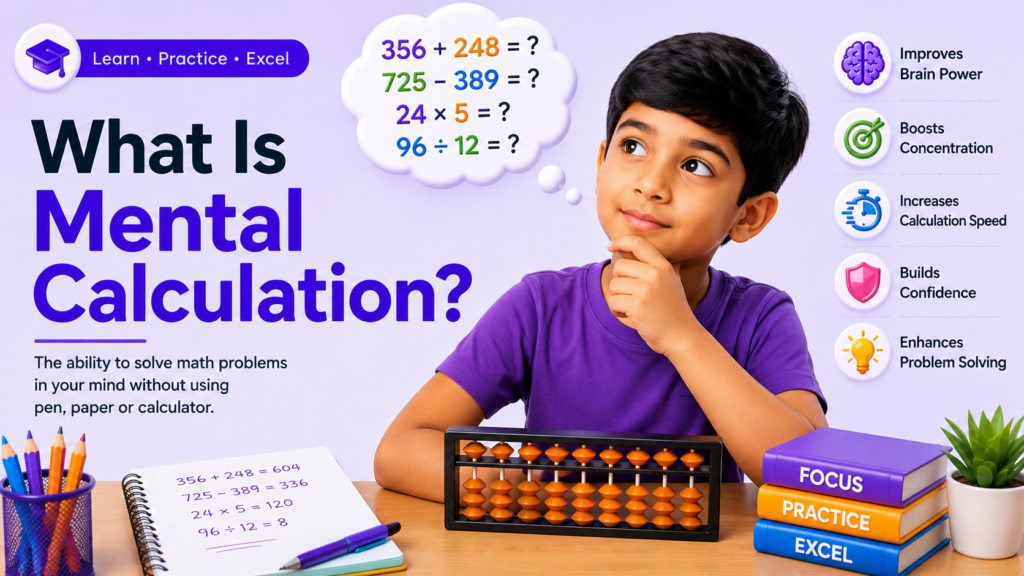
Mental calculation is the ability to solve mathematical problems without using paper, calculators, or other external tools. Children perform calculations entirely in their minds by using memory, concentration, visualization, and logical thinking. These skills not only improve mathematical ability but also contribute to overall intellectual development.
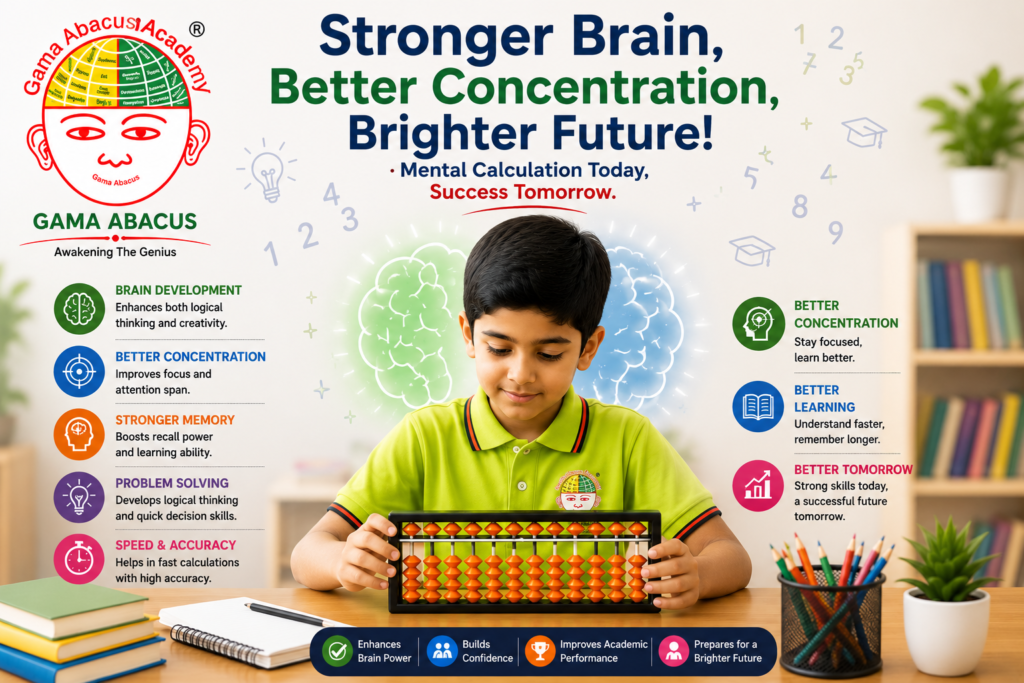
Today, mental calculation has become an essential life skill because children regularly face situations that require quick thinking and accurate decision-making. Whether solving classroom problems, estimating shopping expenses, or participating in competitions, strong mental calculation skills give children greater confidence and independence. This is one reason many parents choose the best abacus classes in india to help their children develop strong mental arithmetic skills from an early age.
What Is Mental Calculation?
Understanding What Is Mental Calculation? Benefits for Children’s Brain Development begins with knowing what mental calculation actually means.
Mental calculation is the process of solving mathematical problems entirely in the mind without relying on written methods or electronic devices. Instead of writing numbers on paper, children use memory, number sense, and logical reasoning to find the correct answer.
Simple examples include:
- Adding two numbers mentally
- Calculating change while shopping
- Multiplying small numbers without writing
- Estimating totals quickly
- Dividing numbers mentally
As children practice regularly, their brains become faster at recognizing numerical patterns and processing information. Over time, calculations that once seemed difficult become almost automatic.
Unlike memorizing formulas alone, mental calculation develops genuine mathematical understanding, allowing children to solve problems with confidence and accuracy.
What Is Mental Calculation Important for Children?
Children use numbers every day, both inside and outside the classroom.
Strong mental calculation skills help children:
- Solve school mathematics more efficiently
- Save time during examinations
- Build confidence while learning
- Make quick everyday calculations
- Improve logical reasoning
More importantly, mental calculation encourages children to think independently instead of depending on calculators for simple arithmetic.
As technology becomes increasingly common, the ability to calculate mentally remains a valuable skill that supports both academic achievement and everyday decision-making.
What Is Mental Calculation? Benefits for Children’s Brain Development Through Better Memory
One of the greatest advantages of mental calculation is its positive effect on memory.
When children solve calculations mentally, they must remember numbers, intermediate answers, and calculation steps at the same time. This continuous mental activity strengthens working memory, which plays an important role in learning across all subjects.
Improved memory helps children:
- Remember mathematical formulas
- Recall classroom lessons
- Learn new concepts faster
- Retain information for longer periods
A strong memory also improves confidence because children trust their ability to remember what they have learned during examinations.
Improves Concentration and Attention
Concentration is one of the most valuable learning skills a child can develop.
Mental calculation requires complete focus because children cannot rely on written notes while solving problems.
During every calculation they must:
- Focus on numbers
- Remember previous steps
- Avoid distractions
- Process information carefully
Regular practice gradually increases attention span.
Children who develop stronger concentration often become more attentive during classroom lessons, homework sessions, and examinations.
Better concentration also reduces careless mistakes, allowing children to complete mathematical problems more accurately.
Develops Visualization Skills
Visualization is an important cognitive ability that supports learning.
Instead of seeing numbers only on paper, children begin creating mental images while solving calculations.
Visualization allows them to:
- Understand number relationships
- Solve complex calculations mentally
- Organize information efficiently
- Think more creatively
This ability becomes even stronger when children learn through abacus training, where they gradually move from a physical abacus to imagining bead movements inside their minds.
As visualization improves, calculation speed and accuracy naturally increase.
Strengthens Logical Thinking
Mathematics is not simply about finding answers.
It teaches children how to think logically.
Mental calculation encourages children to:
- Analyze problems carefully
- Identify number patterns
- Choose appropriate calculation methods
- Verify answers mentally
These logical thinking skills benefit subjects such as science, coding, engineering, and technology.
Children who think logically are also better prepared to solve everyday challenges confidently.
How Abacus Helps Develop Mental Calculation Skills
Abacus is one of the most effective methods for developing mental calculation.
Children first learn calculations using a physical abacus.
As they gain experience, they begin imagining the abacus mentally while moving invisible beads inside their minds.
This unique learning process strengthens:
- Concentration
- Memory
- Visualization
- Observation
- Mental processing speed
- Accuracy
Eventually, children perform calculations mentally without depending on the physical abacus.
This transition makes mental arithmetic both faster and more accurate while supporting overall brain development.
What Is Mental Calculation? Benefits for Children’s Brain Development Through Faster Thinking
One important reason parents value mental calculation is that it develops faster thinking.
Instead of depending on calculators or lengthy written methods, children learn to process information quickly inside their minds.
This helps them:
- Answer classroom questions confidently
- Complete mathematics papers faster
- Participate actively in competitions
- Solve everyday calculations efficiently
Fast thinking does not mean rushing.
Instead, it means developing the ability to process information accurately within a shorter period.
Improves Academic Performance
Academic success depends on much more than memorizing formulas or completing homework. Children also need strong concentration, memory, and problem-solving skills to perform consistently in school.
This is another reason What Is Mental Calculation? Benefits for Children’s Brain Development is important for every parent to understand.
Children with good mental calculation skills often:
- Solve mathematical problems more quickly
- Understand numerical concepts with greater clarity
- Complete classwork confidently
- Participate actively during lessons
- Perform better in examinations
Mental calculation also reduces the time spent on basic arithmetic, allowing children to focus on understanding complex concepts instead of struggling with simple calculations.
Enhances Problem-Solving Abilities
Problem-solving is one of the most valuable life skills a child can develop.
Mental calculation encourages children to think before answering. Instead of depending on memorized methods, they learn to analyze each problem carefully and select the best approach.
As children practice regularly, they develop the ability to:
- Break large problems into smaller steps
- Identify number patterns
- Compare different methods
- Arrive at accurate solutions
These skills benefit subjects beyond mathematics, including science, coding, and logical reasoning activities.
Builds Confidence in Everyday Situations
Children who can calculate mentally often become more confident in daily life.
Simple activities such as calculating shopping expenses, estimating discounts, dividing food equally, or checking change become easier without using a calculator.
This growing independence helps children believe in their own abilities.
Confident learners are more willing to:
- Answer questions in class
- Participate in competitions
- Solve unfamiliar problems
- Learn new concepts without fear
As confidence increases, children develop a more positive attitude toward learning and become less anxious when facing academic challenges.
What Is Mental Calculation? Benefits for Children’s Brain Development Through Better Decision-Making
Mental calculation supports quick and accurate decision-making.
Every calculation requires children to observe information, think logically, and choose the correct answer within a short time.
These repeated mental exercises strengthen cognitive flexibility and improve the brain’s ability to process information efficiently.
Children gradually become better at:
- Estimating values
- Comparing numbers
- Planning solutions
- Making logical choices
These abilities are useful not only in mathematics but also in everyday situations where thoughtful decisions are required.
Everyday Benefits of Mental Calculation
Mental calculation is not limited to school textbooks.
Children use these skills throughout daily life.
Some common examples include:
Shopping
They can estimate the total cost of items and calculate change without depending on a calculator.
Time Management
Children become better at estimating travel time, planning schedules, and organizing daily activities.
Sports and Games
Many sports and board games involve quick calculations, scorekeeping, and strategic thinking.
Competitive Exams
Fast mental calculation saves valuable time, allowing students to concentrate on more challenging questions.
These practical applications make mental calculation an important life skill rather than just an academic exercise.
How Abacus Makes Mental Calculation Easier
Among the many brain-training methods available today, abacus is widely recognized as one of the most effective ways to develop strong mental calculation skills in children.
Children begin with a physical abacus to understand numbers visually.
As their confidence grows, they gradually move to mental visualization, where they imagine the abacus and perform calculations without touching the beads.
This learning process develops:
- Mental visualization
- Working memory
- Concentration
- Observation
- Speed
- Accuracy
Because multiple cognitive skills work together, children become faster and more confident while solving mathematical problems.
Parents searching for the best abacus classes in india often choose structured abacus programs because they provide systematic guidance that helps children master mental calculation while supporting overall brain development.
Long-Term Benefits for Children’s Brain Development
The advantages of mental calculation continue long after childhood.
Regular practice strengthens habits and abilities that support future learning.
Children who develop strong mental calculation skills often demonstrate:
- Better analytical thinking
- Improved concentration
- Faster information processing
- Greater learning confidence
- Stronger memory
- Enhanced creativity
- Better academic independence
These qualities remain valuable throughout higher education and future careers, where logical thinking and problem-solving are essential.
Mental calculation therefore becomes an investment in lifelong learning rather than simply a mathematics skill.
Why Parents Should Encourage Mental Calculation Early
Childhood is the ideal time to develop strong cognitive abilities because the brain is highly adaptable during these years.
Introducing mental calculation early helps children build a solid learning foundation before mathematical concepts become more advanced.
Parents can encourage this development by:
- Promoting daily mental arithmetic practice
- Limiting unnecessary dependence on calculators
- Using educational games involving numbers
- Encouraging children to estimate answers before calculating
- Enrolling children in structured abacus programs
Consistent practice helps transform mental calculation into a natural habit that benefits every stage of education.
What Is Mental Calculation? Benefits for Children’s Brain Development in Everyday Learning
The true value of mental calculation extends beyond faster arithmetic.
It develops concentration, strengthens memory, improves logical reasoning, enhances visualization, and builds confidence. These skills support children in every subject they study while preparing them to solve real-life problems independently.
When children learn to think clearly and calculate mentally, they gain abilities that remain useful throughout their lives.
For this reason, parents increasingly recognize mental calculation as an essential part of modern education.
Conclusion
Understanding What Is Mental Calculation? Benefits for Children’s Brain Development helps parents appreciate that mental calculation is much more than a mathematical technique. It strengthens concentration, improves memory, develops logical thinking, and encourages confident decision-making. When children practice mental calculation regularlyespecially through structured abacus training they build cognitive skills that support academic success and everyday problem-solving. Investing in these abilities during childhood creates a strong foundation for lifelong learning, helping children become confident, independent, and capable learners.