
How to Stop Finger Counting Using Abacus: A Practical Guide for Parents
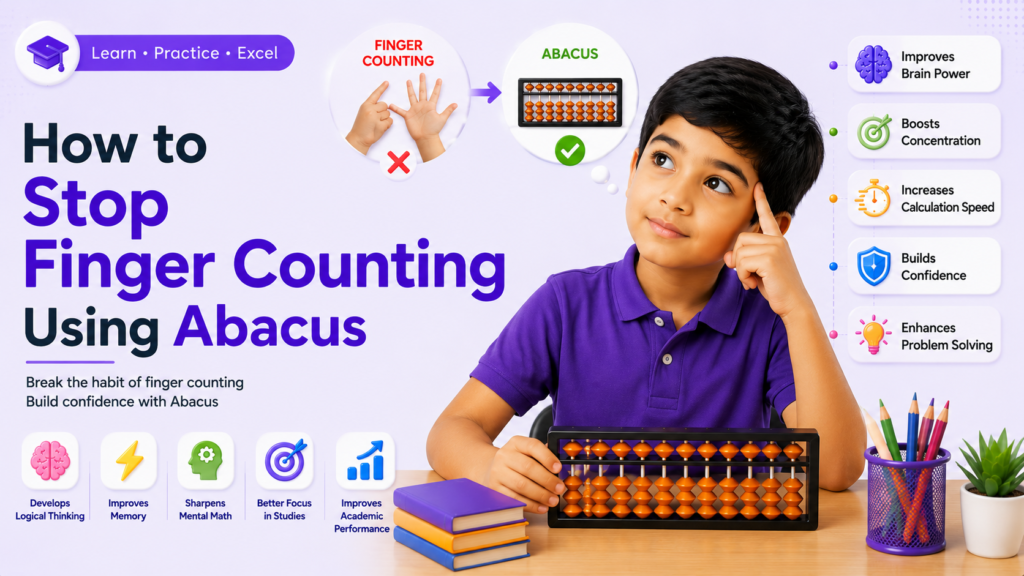
Many parents notice that their child continues to use their fingers for simple calculations long after learning basic addition and subtraction. While finger counting is a normal stage of mathematical development, relying on it for too long can slow down calculation speed and reduce confidence in solving math problems.
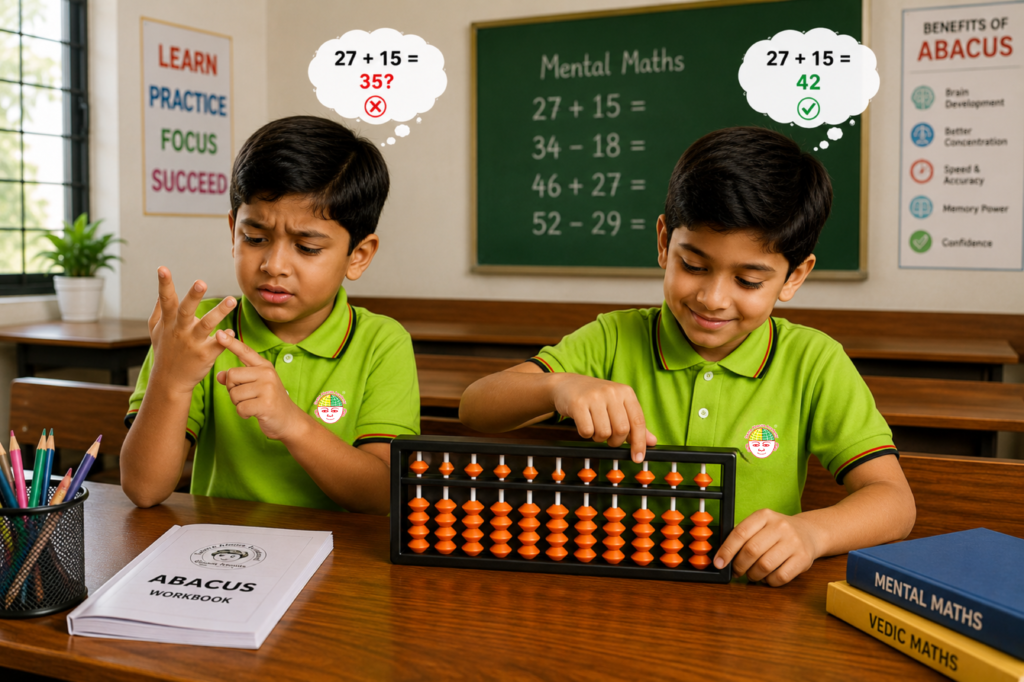
If you’re wondering How to Stop Finger Counting Using Abacus , you’re not alone. Many parents face the same concern and look for a safe, effective, and enjoyable way to help their children build stronger calculation skills.
The good news is that children don’t need to memorize endless formulas or spend hours solving worksheets. With the right training, they can gradually move from finger counting to visual thinking and faster mental calculations. This is where the abacus plays a significant role.
Why Do Children Rely on Finger Counting?
Finger counting is a natural learning method for young children. It helps them understand numbers by connecting physical movement with mathematical concepts.
However, problems arise when children continue depending on their fingers even after learning basic arithmetic.
Some common reasons include:
- Lack of confidence in number recognition
- Weak understanding of number patterns
- Slow calculation speed
- Limited mental visualization skills
- Fear of making mistakes
These habits can affect classroom performance and make mathematics feel more difficult than it actually is.
How to Stop Finger Counting Using Abacus by Building Number Sense
One of the biggest advantages of abacus training is that it develops true number sense instead of encouraging memorization.
Children first learn how numbers are represented on the abacus. Instead of depending on their fingers, they begin visualizing beads while solving problems. Over time, their brain naturally replaces finger movements with mental images.
This gradual transition makes calculations faster, smoother, and far more accurate.
Unlike shortcuts that only teach quick answers, the abacus strengthens the foundation of mathematical thinking.
Why Finger Counting Can Become a Habit
Children often continue finger counting because it feels familiar and comfortable.
Some common situations include:
- Adding numbers one by one
- Counting backwards during subtraction
- Solving homework without confidence
- Feeling nervous during tests
As mathematical concepts become more advanced, finger counting becomes slower and less practical.
Parents may even notice their child hiding their hands under the desk during school tests to continue counting secretly. This isn’t laziness it’s simply a habit that hasn’t yet been replaced with a better strategy.
How to Stop Finger Counting Using Abacus Through Visualization
The greatest strength of abacus education is visualization.
After practicing with a physical abacus, children gradually imagine the beads inside their minds. This technique encourages the brain to process numbers mentally rather than physically.
As visualization improves, children begin solving addition, subtraction, multiplication, and division without needing their fingers.
This shift happens naturally through consistent practice rather than pressure.
The Step-by-Step Transition from Fingers to Mental Calculation
Stage 1: Finger Counting
Children physically count each number using their fingers.
Stage 2: Physical Abacus
Children replace fingers with bead movements.
Stage 3: Mental Visualization
Children imagine moving the beads mentally.
Stage 4: Fast Mental Calculation
Calculations become automatic without finger counting.
Each stage builds confidence while strengthening brain connections.
Benefits of Replacing Finger Counting
Parents often notice positive changes after regular abacus practice.
Some common improvements include:
- Faster calculation speed
- Better accuracy
- Improved confidence
- Stronger memory
- Better concentration
These improvements often extend beyond mathematics into other learning activities as well.
How to Stop Finger Counting Using Abacus Without Pressuring Your Child
One mistake many parents make is repeatedly telling their child:
“Don’t use your fingers.”
Unfortunately, this rarely solves the problem.
Instead, children need a better alternative.
The abacus gives them exactly that.
Rather than removing one habit, it replaces it with a more effective thinking process. Many parents search for How to Stop Finger Counting Using Abacus because they want their children to calculate confidently without depending on their fingers.
Encouragement, patience, and regular practice are far more effective than criticism.
Daily Practice Tips for Parents
Parents can support learning at home with a few simple habits.
- Keep practice sessions short.
- Encourage consistency.
- Celebrate progress.
- Avoid comparing children.
- Make learning enjoyable.
How to Stop Finger Counting Using Abacus is not about forcing children to stop counting. It is about helping them build stronger number sense through regular practice and positive guidance.
How to Stop Finger Counting Using Abacus in School Mathematics
Many parents wonder whether abacus skills transfer to classroom mathematics.
The answer is yes.
Children who visualize numbers mentally often complete school calculations more quickly and with greater confidence.
Teachers frequently observe that children learning How to Stop Finger Counting Using Abacus become faster and more accurate during classroom activities.
Common Myths About Finger Counting
Myth 1: Finger Counting Is Always Bad
Finger counting is perfectly normal during the early stages of learning.
The goal is not to stop immediately but to gradually replace it with stronger mathematical thinking.
Myth 2: Children Must Memorize Everything
Real mathematical ability comes from understanding numbers, not memorizing answers.
Myth 3: Fast Calculation Means Rushing
Speed develops naturally after children understand number relationships.
How to Stop Finger Counting Using Abacus with Consistent Practice
Consistency matters more than intensity.
Parents who understand How to Stop Finger Counting Using Abacus usually notice gradual improvement through regular daily practice. Every child learns at a different pace, and patience is essential throughout the learning journey.
Choosing the Right Learning Environment
A structured learning program guided by experienced instructors helps children develop correct techniques from the beginning.
Whether parents choose abacus classes for kids, a structured mental math classes program, or one of the best abacus classes in India, the key is ensuring that children receive consistent guidance and enjoyable practice. High-quality abacus learning also supports long-term brain development for children, helping children build confidence beyond mathematics.
Conclusion
If you’ve been wondering How to Stop Finger Counting Using Abacus , remember that children don’t need pressure they need the right learning method. Abacus training gradually replaces finger counting with visualization, improves number sense, strengthens confidence, and develops fast mental calculation skills. With consistent practice and patient guidance, children can enjoy mathematics while becoming independent and confident learners.