
Why Does My Child Struggle to Remember Multiplication Tables?
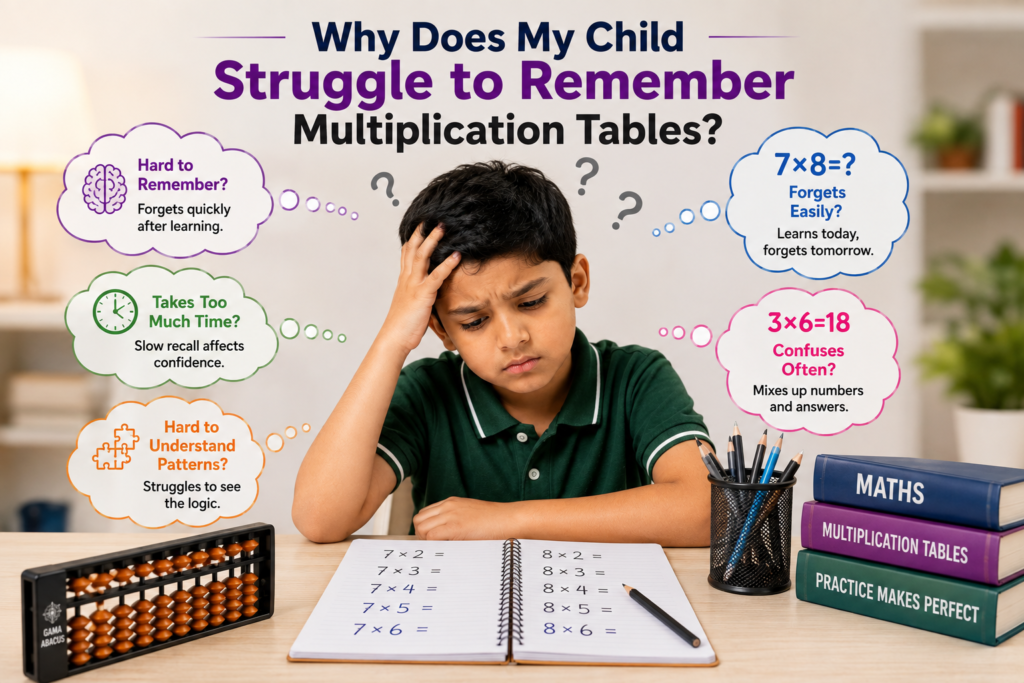
If your child can solve addition and subtraction confidently but becomes stuck when multiplication tables come up, you may be asking, Why Does My Child Struggle to Remember Multiplication Tables? Many parents face this situation with their children. A child may practise a table several times and still forget it the next day. That does not automatically mean the child has a poor memory or cannot learn mathematics. Multiplication facts become easier to recall when children understand number relationships, practise regularly, and have enough opportunities to use what they have learned.
Multiplication tables are important because they support many later maths skills. Children use them when working with division, fractions, measurements, percentages, area, and multi-step problems. When basic facts are not readily available, even a simple question can take extra time.
The good news is that memorising multiplication does not have to depend on endless repetition. Parents can help children understand patterns, use practical examples, practise in short sessions, and develop confidence with numbers.
Why Does My Child Struggle to Remember Multiplication Tables?
There is no single reason every child forgets multiplication facts. Some children try to memorise tables without understanding them. Others practise only before tests and then stop. Some become anxious when asked to answer quickly, while others confuse similar facts.
Before increasing the amount of homework, it is worth finding out what kind of difficulty your child is experiencing. Does the child forget the answer completely? Do they know it but need a long time to recall it? Can they work it out using addition even when they cannot remember it directly?
These differences matter. A child who can reason out 7 × 6 by using 7 × 5 + 7 is developing useful mathematical thinking, even if direct recall is still developing.
Common Reasons Children Forget Multiplication Tables
Rote Memorisation Without Understanding
One of the biggest challenges is learning tables as a list of unrelated answers. If children only repeat a table without seeing how the numbers connect, the information may be harder to retain.
Understanding multiplication as repeated addition, equal groups, arrays, or number patterns gives children more than one way to remember a fact.
For example, knowing that 8 × 4 means four groups of eight gives meaning to the answer. A child can also connect 8 × 4 with doubling 8 × 2. These connections make recall less dependent on pure memorisation.
Irregular Practice
A child cannot always retain a new fact after practising it once or twice. Memory becomes stronger when information is revisited at suitable intervals.
This does not mean children need lengthy study sessions. Five to fifteen minutes of focused practice can be more manageable than an hour of repetitive work.
If you are still wondering, Why Does My Child Struggle to Remember Multiplication Tables?, look at the child’s practice routine. Is there a little practice most days, or is everything left until the night before a test?
Mixing Old and New Facts
Children can sometimes remember a newly learned table while forgetting facts they learned earlier. This happens when practice focuses only on the newest material.
Mixing familiar and unfamiliar facts helps children keep older knowledge active. It also prevents them from relying on the order of a table to find an answer.
For example, instead of asking every question in sequence, parents can ask 6 × 4, 3 × 8, 7 × 5, and 4 × 9 in a mixed order.
Lack of Number Sense
Strong number sense helps children understand how quantities relate to one another. A child who recognises that 6 × 8 is double 3 × 8 has a useful mental strategy even if the exact fact is not immediately available.
When number relationships become familiar, children have more ways to reconstruct an answer.
This is one reason Why Does My Child Struggle to Remember Multiplication Tables? should not be viewed only as a memory question. Sometimes the deeper issue is understanding how numbers work together.
Maths Anxiety and Fear of Mistakes
Some children can recall a multiplication fact at home but freeze when a teacher asks them unexpectedly. Pressure can interfere with recall.
If children associate multiplication with being tested, timed, or corrected in front of others, they may become hesitant.
Parents can reduce this pressure by allowing children enough thinking time and treating mistakes as part of learning. A calm approach can help children practise retrieval without feeling that every answer is a judgement of their ability.
How Parents Can Help Children Remember Multiplication Tables
If you are asking, Why Does My Child Struggle to Remember Multiplication Tables?, start by making practice simple and consistent.
Instead of trying to learn an entire table at once, choose a small group of facts. Practise those facts in different forms and return to them later.
Parents can use everyday examples. If there are four plates with three biscuits on each plate, ask how many biscuits there are altogether. If five children each have six pencils, ask for the total. These situations help children connect multiplication with real quantities.
The goal is to help children understand what multiplication means rather than treating tables as isolated sentences.
Use Patterns to Make Tables Easier
Multiplication contains many patterns that children can use as memory aids.
The 2 times table is based on doubling. The 5 times table follows a simple pattern in the final digit. Multiplying by 10 connects naturally with place value. The 4 times table can be understood as doubling twice.
These relationships give children multiple routes to an answer.
For instance, if a child forgets 7 × 8, they might remember 7 × 4 = 28 and double it. This is not a failure to memorise. It is a useful calculation strategy that can eventually become faster recall.
Why Does My Child Struggle to Remember Multiplication Tables? can often be answered partly by looking at whether the child has been taught thesepatterns.
Encourage Active Recall
Reading a multiplication table repeatedly can create the feeling that a child knows it, but recognition is different from recall.
Active recall means asking the child to produce the answer without looking first.
Parents can ask a few mixed questions, wait patiently, and then discuss the strategy used. Flashcards can also be useful when they are used without creating excessive pressure.
Keep sessions short and stop before the child becomes frustrated. Regular, positive practice is more sustainable than forcing a child to continue after concentration has disappeared.
How Abacus Can Support Multiplication Learning
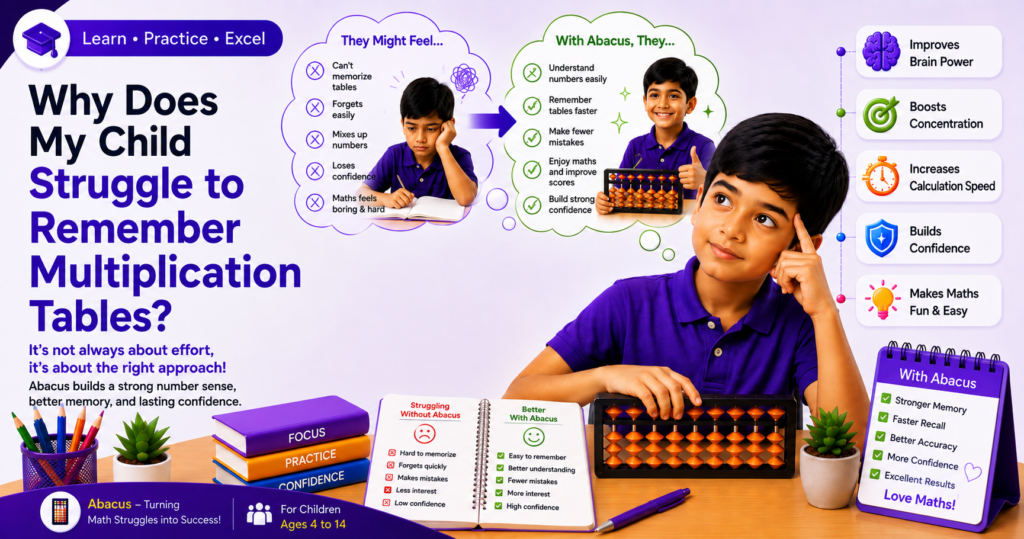
An abacus provides a visual and hands-on way for children to work with quantities and calculations. Instead of seeing multiplication only as a list of facts, children can explore number relationships through bead movements and repeated practice.
With structured abacus learning, children can develop familiarity with numbers while practising calculation skills. As their experience grows, they may gradually learn to visualise the abacus mentally and perform calculations without physically moving the beads.
For a child who struggles with multiplication facts, this approach can make numbers more concrete. It also encourages children to think about how quantities change rather than simply memorising answers.
Why Does My Child Struggle to Remember Multiplication Tables? may have a different answer when the child is given a learning method that suits their way of understanding numbers.
Abacus does not replace school mathematics or guarantee instant memorisation. Its value comes from structured practice, visualisation, concentration, and repeated interaction with numbers.
Choosing the Right Practice Environment
The learning environment matters as much as the activity itself. Parents looking for abacus classes for kids should look for teachers who introduce skills gradually and provide enough practice without creating unnecessary pressure.
When comparing the best abacus classes in India, consider the instructor’s experience, teaching approach, class size, practice structure, and how progress is monitored. A supportive teacher should encourage children to understand their mistakes and improve step by step.
Some children may also benefit from mental math classes when they are ready to work more extensively with numbers mentally. The important thing is to choose support that matches the child’s current level rather than expecting immediate speed.
Make Multiplication Practice More Enjoyable
Children are more likely to practise when the activity feels achievable.
Parents can turn multiplication into small games. Ask children to find all the ways to make a particular number using multiplication. Give them a simple shopping problem. Use dice to create two numbers and multiply them. Ask them to spot multiplication patterns in everyday situations.
These activities can make practice feel less like a test.
It is also helpful to praise the process. Instead of saying only “That’s correct,” parents can say, “You remembered that by using a pattern,” or “You found another way to solve it.”
This type of feedback shows children that their thinking matters.
When Should Parents Seek Additional Support?
If a child continues to struggle with basic multiplication facts despite regular practice, parents can look at whether other foundational skills are also difficult.
For example, does the child struggle with counting in groups, skip-counting, place value, addition, or recognising patterns? Are they becoming extremely frustrated whenever multiplication appears?
These signs may suggest that the child needs additional guidance rather than simply more worksheets.
Parents do not need to wait until a child receives poor marks before seeking support. Early encouragement can prevent small gaps from becoming larger difficulties later.
Why Does My Child Struggle to Remember Multiplication Tables? is therefore worth exploring from several angles: memory, understanding, practice, confidence, and learning method.
Building Skills Beyond Memorisation
Multiplication facts are useful, but the larger goal is mathematical fluency.
Children should gradually become comfortable moving between different representations of numbers. They should be able to use a known fact to work out an unfamiliar one, recognise patterns, and explain their reasoning.
This kind of flexibility is more valuable than simply reciting a table from one to twelve.
A child may initially need a strategy to work out 8 × 7. With practice, that strategy can become automatic. Over time, the child may recall the answer immediately.
Consistent practice also supports concentration and broader brain development for children, especially when activities require them to observe, remember, reason, and respond.
Helping Children Build Confidence
Parents can make a significant difference by avoiding comparisons.
Saying that another child already knows all the tables can make a struggling child feel discouraged. Instead, compare the child’s current ability with their own previous progress.
Maybe they could remember three facts last week and now remember six. Maybe they can now use a pattern instead of counting. Those are meaningful improvements.
If you are still asking, Why Does My Child Struggle to Remember Multiplication Tables?, remember that progress does not always look like instant recall. Better understanding, fewer mistakes, and greater willingness to attempt questions are all signs of development.
Focus on Progress, Not Perfection
Children do not need to remember every multiplication fact perfectly from the beginning.
Some facts may become familiar quickly, while others may need more repetition. Giving children enough time to revisit difficult facts can prevent frustration.
Parents can keep a small record of the facts their child finds difficult and practise those alongside facts the child already knows. This creates a balance between challenge and success.
The purpose is to gradually make multiplication facts easier to retrieve, not to turn every practice session into a race.
Conclusion
Why Does My Child Struggle to Remember Multiplication Tables? It may be because the child is relying too heavily on rote memorisation, practising irregularly, confusing similar facts, lacking number sense, or feeling anxious about mistakes. The solution is not necessarily more worksheets or more pressure. Children can benefit from understanding patterns, using multiplication in real-life situations, practising through active recall, and receiving consistent encouragement. Abacus can provide an additional visual and structured way to work with numbers and strengthen calculation habits. With patience, suitable practice, and the right support, children can gradually move from struggling with multiplication facts to recalling them with greater confidence and ease.